Introduction
If I asked you what the most important number for your health is, what would you say?
Your weight?
Your body fat percentage?
Your bench press?
For many people, those are the first numbers that come to mind.
But there’s another number that many health experts consider one of the strongest indicators of cardiovascular fitness and long-term health:
VO2 max.
Now, before you panic because it sounds like something from a science textbook, don’t worry.
The idea behind VO2 max is actually much simpler than its name.
Imagine your body is a car.
Your muscles are the engine.
Oxygen is the fuel.
Your heart and lungs work together to deliver that fuel so your muscles can keep moving.
VO2 max is simply a way of measuring how well your body uses oxygen during exercise.
The better your body is at using oxygen, the easier it becomes to walk farther, climb stairs, play sports, or keep up with your kids without feeling completely exhausted.
The good news?
You don’t need expensive laboratory equipment or the newest smartwatch to become healthier.
In fact, while knowing your VO₂ max can be interesting, I don’t think it’s something the average person needs to obsess over.
Instead, it’s much more important to understand what VO₂ max tells us and the everyday habits that naturally improve it.
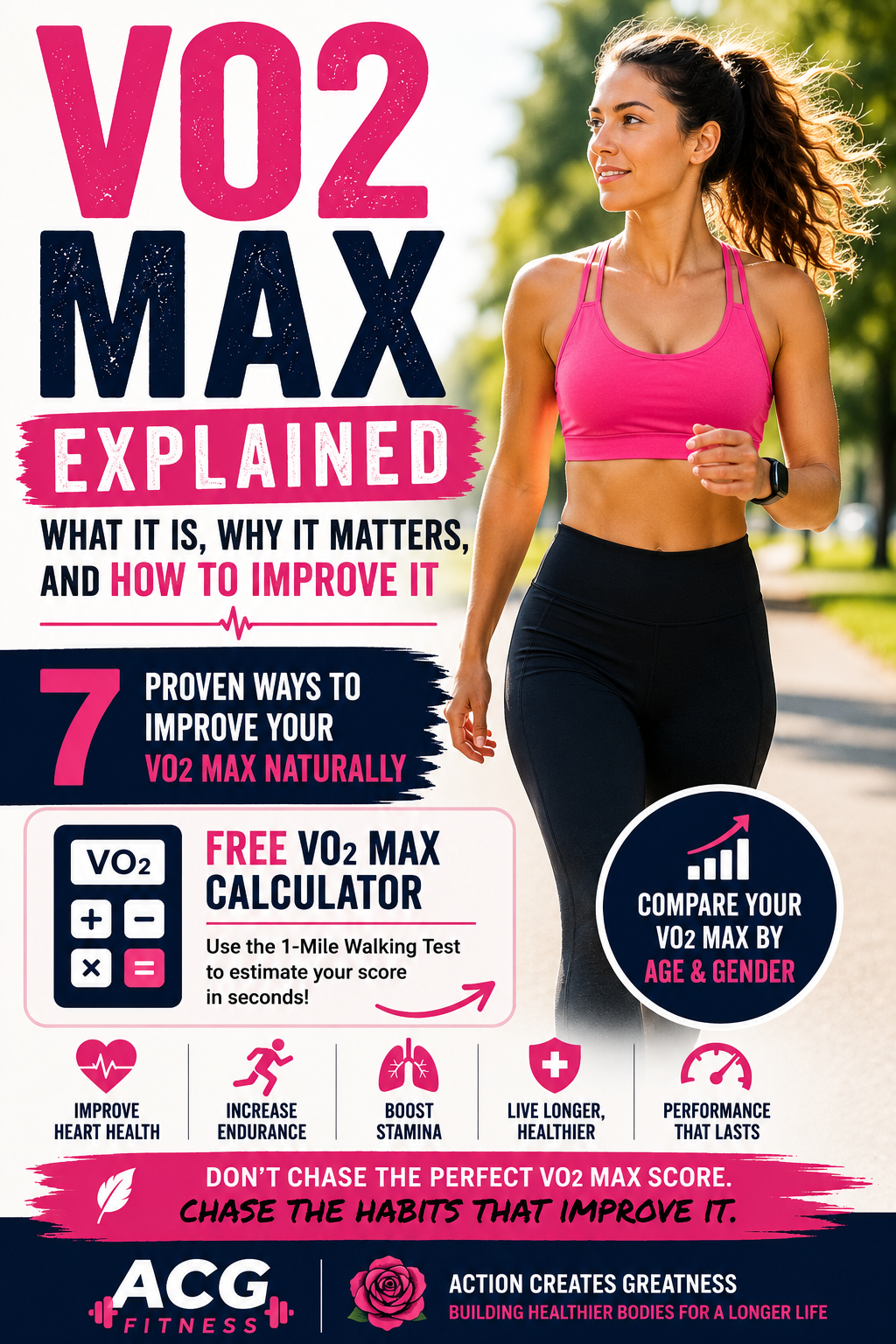
In this guide, you’ll learn what VO₂ max is, why it matters, and seven simple ways to improve it naturally—whether you know your exact score or not.
What Is VO2 Max?
Now that we’ve covered the basics, let’s answer the obvious question.
What is VO2 max exactly?
The term VO2 max stands for maximum oxygen uptake, but don’t let the name intimidate you. The concept is much simpler than it sounds.
Think of your body like a delivery system.
Every time you exercise, your muscles need oxygen to produce energy. Your heart pumps oxygen-rich blood through your body, your lungs bring in fresh oxygen, and your muscles use that oxygen to keep you moving.
VO₂ max is simply a measurement of how much oxygen your body can take in, deliver, and use during intense exercise.
In general, the more efficiently your body moves oxygen from your lungs to your muscles, the easier it becomes to perform physical activity.
That doesn’t necessarily mean someone with a higher VO₂ max is stronger or faster than everyone else. Strength, power, and athletic ability depend on many different factors.
However, a higher VO₂ max usually indicates that your heart, lungs, and muscles are working together efficiently, which is a sign of good cardiovascular fitness.
Don’t worry too much about remembering the scientific definition.
The most important thing to understand is this:
VO₂ max is simply a way of measuring how efficiently your body uses oxygen during exercise.
Why Is VO2 Max Important?
Now that you know what VO2 max is, the next question is:
Why is VO₂ max important?
The answer is simple.
Your heart and lungs work every second of every day to deliver oxygen throughout your body. The more efficiently they can do that, the easier everyday activities become.
Think about climbing a flight of stairs.
Going for a long walk.
Playing basketball with your friends.
Swimming.
Even carrying groceries into your house.
All of these activities rely on your body’s ability to deliver oxygen to your muscles.
That’s why VO₂ max is considered one of the best measurements of cardiovascular fitness.
In fact, many researchers consider VO₂ max for longevity to be one of the strongest predictors of overall health and life expectancy. While it’s certainly not the only factor that matters, people with higher levels of cardiorespiratory fitness generally have a lower risk of heart disease and other chronic health conditions.
That doesn’t mean you need to become an elite runner or obsess over your exact VO₂ max score.
It simply means that improving your cardiovascular fitness can have benefits that go far beyond exercising longer.
A higher VO₂ max may help you:
- Feel less out of breath during everyday activities.
- Improve your endurance.
- Recover more quickly between workouts.
- Support long-term heart health.
- Stay active and independent as you get older.
The good news is that you don’t need to know your exact VO₂ max to enjoy these benefits.
As I mentioned earlier, laboratory testing is the most accurate way to measure VO₂ max, and while many smartwatches can estimate it, they aren’t perfect.
Personally, I think it’s more important to focus on the habits that improve your cardiovascular fitness than to constantly check a number on your watch.
If you consistently exercise, walk more, perform cardio, strength train, and take care of your overall health, your VO2 max will likely improve along the way.
And that’s really what this article is about.
Instead of worrying about chasing the perfect score, let’s focus on how to improve VO2 max naturally so you can become healthier, feel better, and enjoy the long-term benefits of better cardiovascular fitness.
7 Ways to Improve VO₂ Max Naturally

The good news is that improving your VO₂ max doesn’t require expensive equipment or hours of training every day.
Many of the same healthy habits that improve your cardiovascular fitness also support your heart health, endurance, and longevity.
Here are seven science-backed ways to improve your VO₂ max naturally.
1. Make Walking Part of Your Daily Routine
One of the biggest misconceptions about cardiovascular fitness is that you have to run marathons to improve it.
For many people, simply walking more is one of the best places to start.
Walking strengthens your heart, improves circulation, burns calories, and builds the foundation needed for more intense exercise later on.
If you’re just beginning your fitness journey, don’t underestimate the power of increasing your daily steps. Even a brisk walk around your neighborhood can improve your cardiovascular fitness over time.
Related: Walking Wellness Explained
2. Include Zone 2 Cardio in Your Routine
If you’ve been reading ACG Fitness for a while, you’ve probably noticed that I’m a big believer in Zone 2 cardio.
Zone 2 refers to exercising at a moderate intensity where you can still carry on a conversation but your heart is working hard enough to become more efficient.
Over time, this type of training helps your body deliver and use oxygen more effectively, making it one of the best ways to improve VO₂ max naturally.
Whether you prefer brisk walking, cycling, swimming, or jogging, consistency matters more than perfection. These are some of the best exercises to improve VO2 Max
LEARN MORE ABOUT ZONE 2 CARDIO HERE
3. Add High-Intensity Interval Training (HIIT)
While steady-state cardio builds your aerobic base, adding short bursts of higher-intensity exercise can provide another boost to your cardiovascular fitness.
Activities like sprint intervals, rowing, cycling, or hill repeats challenge your heart and lungs to work harder, encouraging your body to adapt over time.
The key is balance.
You don’t need to perform high-intensity workouts every day. Even one or two sessions per week can complement your regular cardio routine.
4. Strength Train Consistently
Many people think lifting weights is only about building muscle.
In reality, strength training supports nearly every aspect of your health.
Building muscle improves movement efficiency, helps maintain a healthy body weight, and complements cardiovascular exercise by making everyday activities feel easier.
If you’re new to resistance training, check out my guide on How to Build Muscle for practical tips on getting started.
5. Maintain a Healthy Weight
You don’t need to have six-pack abs to improve your VO₂ max, but maintaining a healthy weight can make a significant difference.
Remember, VO₂ max measures how efficiently your body uses oxygen during exercise. Carrying excess body fat means your heart and lungs have to work harder to move your body, especially during activities like walking, running, or climbing stairs.
Losing weight—particularly if you’re overweight or obese—can improve your cardiovascular fitness and make physical activity feel easier. It can also reduce your risk of chronic diseases such as heart disease and type 2 diabetes.
The good news is you don’t have to follow an extreme diet to see results.
Focus on eating whole, nutrient-dense foods, controlling your calorie intake, and staying physically active.
Related Articles:
- 5 Calorie Deficit Mistakes That Prevent Weight Loss
- Affordable Keto Diet Foods
- 10 Most Affordable Protein Sources
6. Prioritize Sleep and Recovery

Exercise challenges your body.
Recovery is when your body adapts.
If you’re constantly sleep deprived or training without enough recovery, your workouts can begin to suffer.
Quality sleep supports hormone production, muscle recovery, heart health, and athletic performance—all of which play an important role in improving your cardiovascular fitness over time.
You don’t need perfect sleep every night, but making sleep a priority is one of the simplest ways to support both your workouts and your overall health.
If improving your sleep is one of your goals, check out my guide:
Related: Sleep Hacks That Actually Work
7. Stay Consistent
If there’s one lesson I’ve learned after more than a decade of training, it’s this:
Consistency beats perfection.
You don’t improve your VO₂ max by doing one hard workout.
You improve it by exercising regularly for months and years.
Some weeks you’ll feel great.
Other weeks you’ll be tired, busy, or unmotivated.
That’s normal.
The people who see the biggest improvements aren’t always the most talented—they’re the ones who continue showing up.
Remember, your goal isn’t just to improve one number on a smartwatch.
Your goal is to build a healthier body that allows you to enjoy life for years to come.
That’s why I encourage readers to focus on the bigger picture.
VO₂ max is just one of several important health markers.
If you’re interested in tracking your overall health instead of obsessing over a single metric, be sure to read my guide on Longevity Benchmarks, where I break down the health measurements I believe matter most for living a longer, healthier life.
How Do You Measure Your VO₂ Max?
The most accurate way to measure your VO₂ max is in a laboratory while wearing specialized equipment that measures how much oxygen your body uses during progressively harder exercise.
For most people, that’s unnecessary.
Fortunately, there are several practical ways to estimate your VO₂ max at home.
1. Smartwatch Estimates
Many modern smartwatches can estimate your VO₂ max based on your heart rate, walking pace, running speed, and other health data.
While these estimates aren’t as accurate as laboratory testing, they can be useful for tracking changes over time.
I recommend using the Apple Watch, its effective at not only measuring your VO2 Max but your heart rate, sleep patterns, blood oxygen levels and many more health metrics. I will link to one below on Amazon but feel free to check out other smart watches to get similar features.
Apple Watch Series 11 on Amazon
2. The Rockport One-Mile Walking Test
One of the most popular at-home methods is the Rockport One-Mile Walking Test.
Here’s how it works:
- Walk one mile as quickly as you comfortably can.
- Record how long it takes.
- Immediately measure your heart rate.
- Enter your age, weight, gender, walking time, and heart rate into a VO₂ max calculator.
The result won’t be as accurate as laboratory testing, but it’s a practical way to estimate your cardiovascular fitness and monitor your progress over time.
Try the ACG Fitness Vo2 Max Calculator
After completing the Rockport 1-mile walking test, enter your age, sex, weight, walking time, and heart rate below to estimate your VO2 max. This calculator uses the standard Rockport formula.
VO2 Max Calculator
Use the Rockport 1-mile walking test to estimate your VO2 max.
What Is a Good VO₂ Max by Age?
One of the most common questions people ask is:
“What is a good VO₂ max?”
The answer depends on several factors, including your age, sex, genetics, and activity level.
For example, it’s normal for a healthy 25-year-old to have a higher VO₂ max than a healthy 65-year-old. That’s because our cardiovascular fitness naturally declines with age.
The good news is that regular exercise can slow that decline and help you maintain a higher level of fitness throughout your life.
Instead of comparing yourself to elite athletes or influencers online, compare yourself to people in your own age group and focus on improving over time.
Below is a general guide to VO₂ max ratings for adults.
VO₂ Max Ratings for Men
| Age | 🟢 Excellent | 🔵 Good | 🟡 Average | 🔴 Needs Improvement |
|---|---|---|---|---|
| 20–29 | 52+ | 44–51 | 35–43 | Under 35 |
| 30–39 | 49+ | 42–48 | 33–41 | Under 33 |
| 40–49 | 46+ | 39–45 | 31–38 | Under 31 |
| 50–59 | 43+ | 36–42 | 28–35 | Under 28 |
| 60–69 | 39+ | 33–38 | 25–32 | Under 25 |
| 70+ | 36+ | 30–35 | 22–29 | Under 22 |
VO₂ Max Ratings for Women
| Age | 🟢 Excellent | 🔵 Good | 🟡 Average | 🔴 Needs Improvement |
|---|---|---|---|---|
| 20–29 | 44+ | 37–43 | 29–36 | Under 29 |
| 30–39 | 41+ | 35–40 | 27–34 | Under 27 |
| 40–49 | 39+ | 32–38 | 25–31 | Under 25 |
| 50–59 | 36+ | 30–35 | 22–29 | Under 22 |
| 60–69 | 33+ | 27–32 | 20–26 | Under 20 |
| 70+ | 30+ | 24–29 | 18–23 | Under 18 |
Don’t Obsess Over the Number
As we discussed earlier, your VO₂ max is just one piece of the puzzle.
You can improve your health without ever knowing your exact score.
Personally, I think it’s more important to ask yourself questions like:
- Am I walking farther than I could six months ago?
- Do I get less winded climbing stairs?
- Am I exercising consistently?
- Is my resting heart rate improving?
- Do I have more energy throughout the day?
If the answer to those questions is yes, you’re moving in the right direction—even if you never have your VO₂ max measured in a laboratory.
Remember, your goal isn’t to have the highest VO2 max possible.
Your goal is to become healthier than you were yesterday.
Disclaimer
These VO₂ max ranges are general reference values for healthy adults and should be used as a guide rather than a diagnosis. Your VO₂ max naturally varies based on age, sex, genetics, training history, and overall health. Laboratory testing provides the most accurate measurement, while smartwatches and walking tests offer useful estimates for tracking progress over time.
Frequently Asked Questions About VO2 Max
Can Walking Improve VO2 Max?
Yes. While activities like running and cycling may improve VO₂ max more quickly, brisk walking is an excellent way to build cardiovascular fitness—especially if you’re new to exercise.
Walking strengthens your heart, improves circulation, and increases your aerobic endurance over time. As your fitness improves, you can gradually increase your pace, distance, or intensity.
If you’re just getting started, don’t underestimate the power of a daily walk.
What Is a Good VO2 Max?
A good VO2 max depends on your age and sex.
For example, a healthy VO2 max for a 25-year-old man will naturally be higher than that of a healthy 65-year-old man. Rather than comparing yourself to elite athletes, compare your score to others in your age group and focus on improving over time.
You can use the chart above to see where your estimated VO2 max falls.
How Long Does It Take to Improve VO₂ Max?
Most people can begin seeing improvements in their cardiovascular fitness within 6 to 12 weeks of consistent training.
The biggest factors are consistency, training intensity, recovery, and your current fitness level.
If you’ve been inactive for a while, you may notice improvements sooner than someone who has been training for years.
Can You Improve VO₂ Max After 50?
Absolutely.
Although VO2 max naturally declines with age, regular exercise can slow that decline and even improve your cardiovascular fitness.
Walking, cycling, swimming, strength training, and Zone 2 cardio are all excellent ways to stay active and healthy as you get older.
It’s never too late to improve your fitness.
Are Smartwatches Accurate for Measuring VO2 Max?
Smartwatches such as the Apple Watch, Garmin, and Fitbit can provide useful estimates of your VO₂ max, but they aren’t as accurate as laboratory testing.
I recommend using them to track trends over time rather than focusing on the exact number.
If your estimated VO2 max continues to improve over several months, that’s usually a good sign your cardiovascular fitness is improving as well.
Is VO2 Max the Most Important Fitness Measurement?
VO2 max is one of the best indicators of cardiovascular fitness, but it shouldn’t be viewed in isolation.
A complete picture of your health also includes factors such as your resting heart rate, recovery heart rate, strength, sleep quality, body composition, and daily activity levels.
That’s why I encourage readers to focus on improving healthy habits instead of chasing a single number.
Conclusion
VO2 max may sound like a complicated scientific term, but the idea behind it is actually quite simple.
It’s a measurement of how efficiently your body uses oxygen during exercise, giving you valuable insight into your cardiovascular fitness and overall health.
While knowing your VO2 max can be helpful, I don’t think it’s something the average person needs to obsess over.
Whether you measure it with a laboratory test, estimate it using a smartwatch, or use the Rockport One-Mile Walking Test, remember that the number itself isn’t what makes you healthier.
Your daily habits do.
Walking more.
Strength training consistently.
Improving your cardiovascular fitness.
Eating a balanced diet.
Prioritizing sleep and recovery.
Those are the actions that lead to a healthier heart, a stronger body, and a higher VO₂ max over time.
At ACG Fitness, I believe it’s important to understand your health metrics, but it’s even more important to understand what influences them.
Action creates greatness, not metrics.
VO2 max is simply one way to measure the results of the actions you take every day.
Walk more.
Train consistently.
Prioritize sleep.
Eat nutritious foods.
Take care of your body.
Over time, your VO2 max will likely improve right alongside your overall health.
And that’s a goal worth working toward.

One thought on “VO2 Max: What It Is, Why It Matters, and 7 Ways to Improve It Naturally”