Introduction
For decades, the fitness industry has been obsessed with aesthetics.
Six-pack abs.
Bigger biceps.
The perfect beach body.
Social media only amplified this trend. Open Instagram and you’ll find countless influencers showing off luxury lifestyles, perfect physiques, and unrealistic expectations. While there is nothing wrong with wanting to look your best, many people are beginning to realize that looking healthy and being healthy are not always the same thing.
As I get older, I find myself caring less about whether I can see my abs and more about whether I can still move well, maintain my strength, avoid disease, and stay independent for as long as possible. In other words, I care more about longevity than aesthetics.
Longevity is not simply about living longer. It is about increasing your healthspan—the number of years you can enjoy life with good health, energy, mobility, and independence. After all, adding years to your life means very little if those years are spent struggling with chronic disease, poor mobility, or a loss of independence.
The good news is that you do not need expensive genetic testing, a team of doctors, or the latest biohacking gadget to get a better understanding of your health. In fact, some of the most important longevity benchmarks can be measured with little more than a stopwatch, a fitness tracker, or your own body weight.
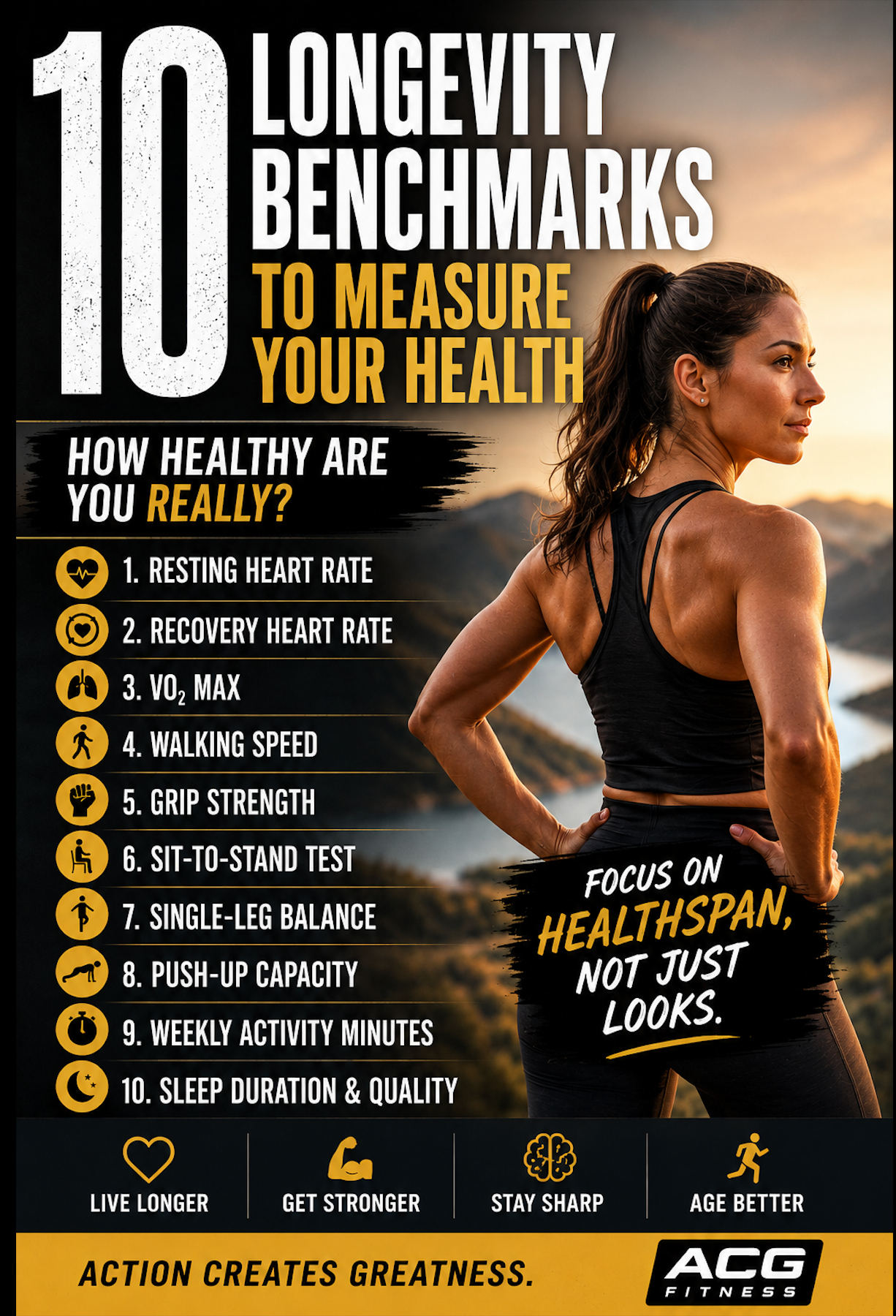
In this article, we will look at 10 longevity benchmarks everyone should know. These simple tests can help you identify strengths, weaknesses, and opportunities to improve your health before small problems become much larger ones.
So before you worry about building bigger arms or losing those last five pounds, ask yourself a more important question:
How healthy are you really?
Longevity Score Card
As we work through these longevity benchmarks, consider keeping track of your results. In fact, I am currently developing an ACG Fitness Longevity Scorecard that will help readers track these metrics and get a clearer picture of their overall healthspan.
While no score can perfectly predict how long you will live, these benchmarks can provide valuable insight into where you are doing well and where there may be opportunities for improvement.
Think of it as a report card for your health. The goal isn’t to get a perfect score. The goal is to identify areas where you can take action and improve over time.
What Does It Mean To Be Healthy?
Before we get into these longevity benchmarks, it’s important to understand what health actually means.
Many people think health can be determined by a single number. Maybe it’s the number on the scale, your BMI, body fat percentage, or even your blood pressure. While all of those things can provide useful information, none of them tell the whole story.
For example, being overweight does not automatically mean someone is unhealthy. According to BMI charts, I am technically overweight for my height. However, much of that weight comes from years of strength training and building muscle. On the other hand, someone may appear thin on the outside while struggling with poor cardiovascular fitness, low muscle mass, poor sleep habits, or unhealthy lifestyle choices.
That’s why health should be viewed through multiple lenses.
A healthy person is generally someone who can move well, maintain their independence, recover from physical activity, manage stress, perform daily tasks, and reduce their risk of chronic disease. No single test can measure all of those qualities.
The benchmarks in this article are not a definitive checklist that determines whether you are healthy or unhealthy. Instead, they are practical indicators that can help paint a clearer picture of your overall health and longevity.
You do not need to score perfectly in every category. In fact, very few people will. The goal is not perfection. The goal is awareness.
These benchmarks can help you identify what you are doing well and, perhaps more importantly, where you have opportunities to improve. Think of them as a health report card. A lower score in one area doesn’t mean you have failed. It simply highlights an area that may deserve more attention.
Long-time readers of ACG Fitness know that I am a huge Kobe Bryant fan. One of my favorite Kobe quotes is:
“Failure doesn’t exist. It’s a learning lesson.”
I think that mindset applies perfectly here.
Maybe your balance isn’t where it should be.
Maybe your VO2 Max needs improvement.
Maybe you aren’t getting enough sleep.
That doesn’t mean you’re unhealthy or that you’ve failed. It simply means you’ve identified an area where you can improve. The purpose of these longevity benchmarks is not to judge yourself against others. The purpose is to learn more about your health and take action where it matters most.
After all, longevity is not built through perfection. It is built through consistent action over time.
With that in mind, let’s look at 10 longevity benchmarks everyone should know.
1. Resting Heart Rate

What Is Resting Heart Rate?
Resting heart rate (RHR) is the number of times your heart beats per minute while your body is completely at rest. For most people, the best time to measure resting heart rate is first thing in the morning before getting out of bed.
Your heart rate naturally rises throughout the day as you move, exercise, work, and deal with everyday stress. Resting heart rate removes many of those variables and provides a snapshot of how hard your heart has to work when your body is at rest.
Today, many fitness trackers and smart watches can automatically track your resting heart rate. Devices such as an Apple Watch, Garmin watch, Fitbit, or smart ring make it easier than ever to monitor this important health metric. However, you can also measure your pulse manually if you do not own any fitness technology.
Why Is Resting Heart Rate Important?
When discussing longevity benchmarks and healthy aging, resting heart rate is one of the easiest and most useful metrics to track.
In general, a lower resting heart rate indicates that your heart is functioning more efficiently. A stronger heart can pump more blood with each beat, which means it does not need to beat as frequently to meet your body’s demands.
This is one reason endurance athletes often have surprisingly low resting heart rates. Their cardiovascular systems have adapted to years of training, allowing their hearts to work more efficiently.
A higher resting heart rate may be influenced by several factors including:
- Poor cardiovascular fitness
- Chronic stress
- Lack of sleep
- Smoking
- Obesity
- Certain medical conditions
While resting heart rate should never be viewed in isolation, it can serve as an excellent indicator of overall cardiovascular health and healthspan.
What Is A Good Resting Heart Rate?
For most adults:
- Excellent: 50-60 BPM
- Good: 60-70 BPM
- Average: 70-80 BPM
- Needs Improvement: 80+ BPM
Keep in mind that genetics, medications, age, and fitness level can all influence resting heart rate. The goal is not to compare yourself to someone else. The goal is to improve from where you are today.
For example, if your resting heart rate decreases from 78 BPM to 68 BPM over the next six months, that is a meaningful improvement even if you never reach the levels of an elite athlete.
As for me, my resting heart rate is typically between 55 and 60 BPM. Now before anyone starts thinking I am some elite endurance athlete, let me be clear: I am not. I enjoy lifting weights, boxing, swimming, walking, and Zone 2 cardio, but I am far from a professional athlete.
The reason I bring this up is because many people assume you need to train for marathons or spend hours in the gym every day to improve your cardiovascular fitness. In reality, consistently following the basics can go a long way. Regular exercise, quality sleep, stress management, and maintaining a healthy body weight can all have a positive impact on your resting heart rate over time.
If you’re interested in learning more, I recently wrote an article explaining exactly how I lowered my resting heart rate and the habits that helped me get there.
How To Improve Your Resting Heart Rate
The good news is that many of the same habits that improve longevity and healthy aging can also help improve your resting heart rate.
Some of the most effective strategies include:
- Walking more throughout the day
- Performing regular Zone 2 cardio
- Strength training consistently
- Maintaining a healthy body weight
- Improving sleep quality
- Managing daily stress levels
Notice that none of these strategies require expensive equipment or complicated biohacks. They are the same fundamental habits that support nearly every aspect of long-term health.
I wrote an article linked here about “How I Lowered My Resting Heart Rate in 7 Steps” that I encourage you all to check out to learn more from.
ACG Fitness Takeaway
If I could only track one cardiovascular longevity benchmark, resting heart rate would be near the top of the list. It is simple, affordable, easy to measure, and often improves long before you notice changes in the mirror.
Many people focus on losing weight or looking better, but your resting heart rate can tell a much deeper story about your overall cardiovascular fitness and long-term health.
Remember, the goal is not to achieve a perfect number. The goal is to gradually improve your healthspan by building habits that help your heart work more efficiently for years to come.
2. Recovery Heart Rate

What Is Recovery Heart Rate?
While resting heart rate measures how efficiently your heart works when your body is at rest, recovery heart rate measures how quickly your heart returns to normal after exercise.
Think of it this way. When you exercise, your heart rate increases to deliver more oxygen and nutrients to your muscles. Once the exercise is over, your body begins the recovery process and your heart rate gradually slows down.
Recovery heart rate is simply a measure of how quickly that happens.
A healthy cardiovascular system can recover more quickly after physical activity, while a slower recovery may indicate lower cardiovascular fitness or excessive fatigue.
Why Is Recovery Heart Rate Important?
Recovery heart rate is one of the most overlooked longevity benchmarks, but it can provide valuable insight into your cardiovascular health.
Research has shown that people with faster heart rate recovery tend to have better cardiovascular fitness and lower risks of certain health complications. In simple terms, a heart that can speed up when needed and slow down efficiently afterward is generally a sign of a healthier cardiovascular system.
Your recovery heart rate can also tell you how well your body is adapting to your current fitness routine.
For example, many people notice that their recovery heart rate improves after consistently walking, performing Zone 2 cardio, swimming, cycling, or participating in other forms of aerobic exercise.
How To Measure Recovery Heart Rate
The test is surprisingly simple.
- Perform a challenging workout or cardio session.
- Immediately record your heart rate when you stop exercising.
- Wait one minute.
- Record your heart rate again.
- Subtract the second number from the first.
For example:
- Heart rate immediately after exercise: 150 BPM
- Heart rate after one minute: 125 BPM
- Recovery heart rate: 25 BPM
Many fitness trackers, smart watches, and smart rings can help automate this process, making it easier to track over time.
What Is A Good Recovery Heart Rate?
As a general rule:
- Excellent: 25+ BPM drop after one minute
- Good: 18-24 BPM drop
- Average: 12-17 BPM drop
- Needs Improvement: Less than 12 BPM drop
Remember that age, medications, fitness level, and exercise intensity can all affect your results.
The goal is not to obsess over a single test. Instead, look for trends over time.
How To Improve Your Recovery Heart Rate
The same habits that improve overall cardiovascular fitness can also improve recovery heart rate.
Some of the most effective strategies include:
- Consistent Zone 2 cardio
- Walking more throughout the day
- Swimming
- Cycling
- Maintaining a healthy weight
- Improving sleep quality
- Managing stress
The good news is that you don’t need to train like a professional athlete to see improvement. Small improvements in cardiovascular fitness often lead to noticeable improvements in recovery heart rate.
ACG Fitness Takeaway
Many people focus on how hard they can train. I think an equally important question is how well your body recovers afterward.
A faster recovery heart rate is often a sign that your cardiovascular system is becoming stronger and more efficient. While it may not be as popular as metrics like weight loss or body fat percentage, it can tell you a lot about your long-term health and healthspan.
Think of recovery heart rate as your body’s ability to bounce back. And when it comes to longevity, the ability to recover is just as important as the ability to perform.
3. VO2 Max
Before We Begin
If you’ve been paying attention, you may have noticed a pattern.
So far, we’ve discussed resting heart rate and recovery heart rate. While they are different longevity benchmarks, they are closely connected.
Generally speaking, as your cardiovascular fitness improves, your resting heart rate often decreases, your recovery heart rate improves, and your VO2 Max tends to increase.
This is because all three benchmarks are measuring different aspects of how efficiently your heart, lungs, and muscles work together to deliver and utilize oxygen throughout your body.
In other words, the body works as a system. Improving one area often creates positive effects elsewhere.
What Is VO2 Max?
VO2 Max measures the maximum amount of oxygen your body can use during intense exercise.
Think of oxygen as fuel for your muscles. The more efficiently your body can take in oxygen, transport it through the bloodstream, and use it during physical activity, the higher your VO2 Max will be.
Many longevity experts consider VO2 Max one of the strongest predictors of long-term health and lifespan because it reflects the overall efficiency of your cardiovascular system.
In simple terms, VO2 Max helps answer an important question:
How well can your body perform physical work?
Why Is VO2 Max Important?
VO2 Max has become one of the most talked-about healthy aging and longevity metrics in recent years, and for good reason.
Research has consistently shown that individuals with higher VO2 Max scores tend to have lower risks of cardiovascular disease and all-cause mortality.
While many people focus on body weight or appearance, VO2 Max provides a much clearer picture of your cardiovascular fitness and overall healthspan.
A higher VO2 Max generally means:
- Better endurance
- Better cardiovascular health
- Improved oxygen delivery
- Greater exercise capacity
- Better long-term health outcomes
This is one reason many longevity experts place such a strong emphasis on aerobic exercise.
How To Measure VO2 Max
The most accurate way to measure VO2 Max is through laboratory testing while exercising on a treadmill or stationary bike.
However, most people don’t need a laboratory test.
Today, many fitness trackers estimate VO2 Max including:
- Apple Watch
- Garmin Watch
- Fitbit
- Certain smart rings
While these estimates may not be perfect, they can still provide a useful way to track progress over time.
What Is A Good VO2 Max?
VO2 Max varies significantly based on age and gender, which makes it difficult to provide a single benchmark.
Generally speaking:
Excellent)
- Top 25% for your age and gender
(Good)
- Above Average for your age and gender
(Average)
- Average for your age and gender
(Needs Improvement)
- Below Average for your age and gender
Because VO2 Max is highly age-dependent, I plan to create a dedicated article covering VO2 Max benchmarks by age and explaining how to improve your score in greater detail.
How To Improve VO2 Max
The good news is that many of the same habits we’ve already discussed can improve VO2 Max.
Some of the most effective strategies include:
- Zone 2 cardio
- Walking
- Swimming
- Cycling
- Running
- High-intensity interval training (HIIT)
Consistency matters far more than perfection. Small improvements over time can lead to meaningful increases in cardiovascular fitness.
ACG Fitness Takeaway
If I had to choose just one longevity benchmark to improve, VO2 Max would be near the top of my list.
It reflects how efficiently your body uses oxygen, how well your cardiovascular system functions, and how prepared you are for the physical demands of daily life.
The best part?
You don’t need expensive supplements or complicated biohacks to improve it.
You simply need to move your body consistently.
And as we’ve already seen with resting heart rate and recovery heart rate, improving your cardiovascular fitness often creates benefits across multiple longevity benchmarks at the same time.
One reason I like VO2 Max so much is because it reminds us that physical appearance is not always an accurate measure of health.
A person can have visible abs, large muscles, and look incredible in a T-shirt while still struggling with cardiovascular fitness.
Take bodybuilding as an example. Many bodybuilders are incredibly strong and have impressive physiques, but some would be completely exhausted after running a mile. On the other hand, a recreational runner may not have the most impressive physique but could have exceptional cardiovascular fitness and a much higher VO2 Max.
This doesn’t mean one person is healthier than the other in every category. It simply highlights the fact that health is multifaceted.
That’s one of the reasons we’re looking at multiple longevity benchmarks instead of relying on a single metric. Aesthetic appearance can tell part of the story, but it doesn’t tell the whole story.
You can learn more about VO2 Max in my latest article here.
HOW TO IMPROVE YOUR VO2 MAX NATURALLY
4. Walking Speed Test

What Is Walking Speed?
Walking speed is exactly what it sounds like: how quickly you can walk from one point to another.
It may seem too simple to be included among important longevity benchmarks, but don’t let its simplicity fool you. Researchers often refer to walking speed as the “sixth vital sign” because of its strong connection to overall health and longevity.
Walking requires multiple systems within the body to work together including:
- Muscular strength
- Balance
- Coordination
- Cardiovascular fitness
- Joint health
- Neurological function
When one or more of these systems begins to decline, walking speed often declines as well.
Why Is Walking Speed Important?
One of the main goals of healthy aging is maintaining independence.
Most people don’t spend much time thinking about their walking speed in their 30s or 40s, but the ability to move confidently and efficiently becomes increasingly important as we age.
Research has consistently shown that faster walking speeds are associated with better health outcomes and lower mortality risk. In many cases, a person’s walking speed can provide insight into their overall healthspan and physical function.
Think about it this way.
If two people are the same age, but one person can comfortably walk long distances without becoming fatigued while the other struggles after a few minutes, who is more likely to remain active and independent over the next decade?
Walking speed isn’t just about moving faster. It’s often a reflection of what’s happening throughout the entire body.
How To Measure Walking Speed
You don’t need a stopwatch, measuring tape, or complicated formula to get a general idea of your walking speed.
A simple way to measure this benchmark is to see how long it takes you to walk one mile at a comfortable pace.
As a general guideline:
- Casual Stroll / Beginner: 24-30 minutes (2-2.5 mph)
- Moderate / Average Pace: 15-20 minutes (3-4 mph)
- Brisk Walk: 12-15 minutes (4-5 mph)
Keep in mind that age, terrain, weather, and fitness level can all affect your results. The goal isn’t to obsess over a specific pace. Instead, use these ranges as a benchmark and look for gradual improvements over time.
If you’re already tracking walks with an Apple Watch, Garmin, Fitbit, or smartphone app, you can also use your average pace as a reference point.
What Is A Good Walking Speed?
For most adults:
- Excellent: Under 15 minutes per mile
- Good: 15-20 minutes per mile
- Average: 20-24 minutes per mile
- Needs Improvement: Over 24 minutes per mile
Keep in mind that age, injuries, and mobility limitations can affect your results.
As with every benchmark in this article, the goal is not to compare yourself to someone else. The goal is to establish a baseline and improve over time.
How To Improve Walking Speed
The best way to improve walking speed is surprisingly simple.
Walk more.
Additional strategies include:
- Strength training
- Zone 2 cardio
- Balance exercises
- Mobility work
- Maintaining a healthy body weight
Even small improvements in strength and cardiovascular fitness can translate into noticeable improvements in walking performance.
ACG Fitness Takeaway
One reason I like this benchmark so much is because almost anyone can measure it.
You don’t need expensive equipment.
You don’t need a gym membership.
You don’t need a smartwatch.
You simply need a safe place to walk.
Walking speed is a reminder that longevity doesn’t have to be complicated. Sometimes the simplest tests provide some of the most valuable information about your overall health.
And if you’ve been paying attention, you’ll notice another pattern emerging. Improving your cardiovascular fitness through walking, Zone 2 cardio, and regular exercise can help improve your walking speed, resting heart rate, recovery heart rate, and VO2 Max at the same time.
That’s the beauty of these longevity benchmarks. They’re all connected.
5. Grip Strength
What Is Grip Strength?
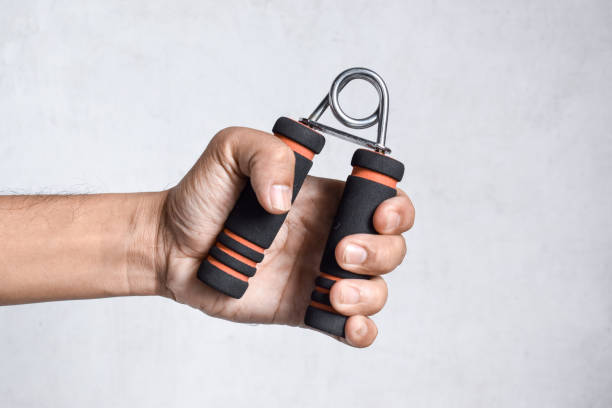
Grip strength refers to the amount of force your hands and forearms can generate when squeezing or holding an object.
At first glance, grip strength may seem like a strange longevity benchmark. After all, most people don’t spend much time thinking about how strong their hands are.
However, grip strength is about much more than having a firm handshake.
Researchers often use grip strength as a simple way to assess overall muscular strength, physical function, and healthy aging. In many cases, grip strength serves as a snapshot of your body’s ability to generate and maintain force.
Why Is Grip Strength Important?
One of the biggest reasons grip strength receives so much attention in longevity research is because it tends to correlate with overall strength and physical function.
Think about how often grip strength is involved in everyday life:
- Carrying groceries
- Opening jars
- Lifting weights
- Holding onto railings
- Moving furniture
- Maintaining balance during a fall
As we age, losing strength often means losing independence.
A person with poor grip strength may struggle with simple daily tasks that younger people take for granted.
Numerous studies have also found that lower grip strength is associated with increased risks of disability, hospitalization, and all-cause mortality.
In other words, grip strength isn’t really about your hands.
It’s about the overall health and function of your body.
How To Measure Grip Strength
The most accurate method is using a grip dynamometer, which measures the amount of force you can generate while squeezing.
However, most people don’t have one lying around at home.
A practical alternative is the dead hang test.
Simply hang from a pull-up bar and see how long you can hold yourself up before your grip gives out.
What Is A Good Grip Strength Score?
Using the dead hang test as a practical benchmark:
- Excellent: 60+ seconds
- Good: 30-60 seconds
- Average: 15-30 seconds
- Needs Improvement: Less than 15 seconds
As with all longevity benchmarks, age, body weight, injuries, and training experience can influence your results.
The goal is not to compare yourself to someone else. The goal is to establish a baseline and improve over time.
How To Improve Grip Strength
The good news is that grip strength often improves naturally when you participate in regular strength training.
Some of the best exercises include:
- Deadlifts
- Farmer’s Carries
- Pull-Ups
- Rows
- Dead Hangs
- Carrying heavy objects safely
Even something as simple as carrying groceries without using a cart can challenge your grip and forearms.
Read are article here: How to Improve Grip Strength: 7 Best Exercises for Strength and Longevity
ACG Fitness Takeaway
One thing I like about grip strength is that it reminds us that longevity is not just about cardiovascular fitness.
Yes, your heart matters.
Yes, your VO2 Max matters.
But maintaining strength matters too.
After all, what good is having a strong heart if you struggle to carry groceries, climb stairs, or perform everyday tasks?
One of the biggest goals of healthy aging is maintaining independence. Grip strength may seem like a small thing, but it can tell us a lot about our ability to remain active, capable, and self-sufficient as we get older.
And if you’ve been paying attention, you’ll notice another pattern. Just like walking speed reflects multiple systems working together, grip strength is often a reflection of overall muscular strength and physical function.
Once again, the body works as a system.
6. Sit-to-Stand Test

What Is the Sit-to-Stand Test?
The Sit-to-Stand Test, sometimes called the Sitting-Rising Test, measures your ability to move from a seated position on the floor to a standing position and back again.
At first glance, this may not sound particularly impressive.
However, this simple movement requires multiple physical qualities working together, including:
- Strength
- Balance
- Mobility
- Coordination
- Flexibility
As we age, these abilities naturally decline if they are not regularly challenged. The Sit-to-Stand Test provides a simple way to evaluate how well your body is maintaining these important functions.
Why Is the Sit-to-Stand Test Important?
One of the biggest goals of healthy aging is maintaining independence.
Most people don’t worry about getting up from the floor when they’re young. But as we get older, this simple movement can become surprisingly difficult.
Think about everyday situations:
- Playing with grandchildren
- Gardening
- Household chores
- Recovering from a stumble or fall
All of these activities require a combination of strength, balance, and mobility.
Research has even found associations between performance on the Sitting-Rising Test and long-term mortality risk. While no single test can predict how long you will live, the ability to move efficiently from the floor to a standing position provides valuable insight into overall physical function.
How To Perform the Sit-to-Stand Test
Find a safe, open area with enough space to move comfortably.
- Sit down on the floor.
- Attempt to stand up without using your hands, knees, furniture, or other assistance if possible.
- Return to the floor under control.
- Note how much assistance you needed.
The less assistance required, the better your score.
If you have mobility limitations or injuries, modify the test as needed and always prioritize safety.
What Is a Good Score?
A simple way to evaluate your performance is:
- Excellent: Sit and stand without using hands or knees
- Good: Use one hand for assistance
- Average: Use both hands
- Needs Improvement: Significant assistance required
Remember, the purpose of this benchmark is not to embarrass anyone. It is simply a snapshot of your current level of mobility and functional fitness.
How To Improve Your Sit-to-Stand Ability
The good news is that this benchmark is highly trainable.
Some of the best ways to improve include:
- Strength training
- Squats
- Lunges
- Mobility exercises
- Yoga
- Balance training
- Practicing getting up and down from the floor safely
Small improvements in lower-body strength and mobility can make a significant difference over time.
ACG Fitness Takeaway
One thing I like about the Sit-to-Stand Test is that it doesn’t care how much weight you can bench press or how impressive you look in the mirror.
It focuses on something far more important:
Can you move your body efficiently?
This benchmark is another reminder that longevity is about maintaining the ability to perform everyday activities with confidence and independence.
And if you’ve been paying attention, you’ll notice that this test is connected to several of the benchmarks we’ve already discussed. Better strength, better balance, more physical activity, and better cardiovascular fitness all make it easier to move well.
Once again, the body works as a system.
7. Single-Leg Balance Test

What Is the Single-Leg Balance Test?
The Single-Leg Balance Test measures your ability to stand on one foot for a period of time without losing your balance.
It sounds simple.
In fact, many people reading this article may think they can easily pass this longevity benchmark.
Give it a try before making that assumption.
Balance is one of those physical abilities we often take for granted until it begins to decline. Like strength and cardiovascular fitness, balance naturally decreases with age if it is not regularly challenged.
The Single-Leg Balance Test provides a quick and practical way to assess an important component of healthy aging.
Why Is the Single-Leg Balance Test Important?
One of the biggest threats to independence as we age is falling.
According to the CDC, falls are a leading cause of injury among older adults. While balance is certainly not the only factor involved, maintaining good balance can significantly reduce the risk of falls and improve overall mobility.
Balance also requires several systems within the body to work together, including:
- Muscle strength
- Joint stability
- Coordination
- Vision
- Nervous system function
When one of these systems begins to decline, balance often declines as well.
This is one reason the Single-Leg Balance Test has become one of the more popular longevity tests among healthy aging experts.
How To Perform the Single-Leg Balance Test
Find a safe area where you can stand comfortably.
- Stand on one foot.
- Keep your hands at your sides.
- Time how long you can maintain your balance.
- Repeat on the other leg.
For safety, perform the test near a wall or sturdy object if you are concerned about falling.
What Is a Good Score?
As a general guideline:
- Excellent: 30+ seconds
- Good: 20-30 seconds
- Average: 10-20 seconds
- Needs Improvement: Less than 10 seconds
If you can comfortably exceed 30 seconds, consider trying the test with your eyes closed for an additional challenge.
How To Improve Balance
Like most longevity benchmarks, balance can improve with consistent practice.
Some effective strategies include:
- Standing on one leg daily
- Strength training
- Yoga
- Tai Chi
- Walking
- Core exercises
Even a few minutes of balance training each day can produce meaningful improvements over time.
ACG Fitness Takeaway
One thing I like about the Single-Leg Balance Test is that it highlights an often-overlooked aspect of healthy aging.
Most people focus on building muscle or improving cardiovascular fitness, but maintaining balance is equally important if your goal is to remain active and independent.
The ability to catch yourself after a stumble, navigate uneven surfaces, or simply move confidently throughout your day can have a significant impact on your long-term healthspan.
And once again, you’ll notice a familiar pattern.
Improving your strength, mobility, activity levels, and cardiovascular fitness often helps improve your balance as well.
These longevity benchmarks don’t exist in isolation.
They are all connected.
8. Push-Up Capacity
What Is Push-Up Capacity?
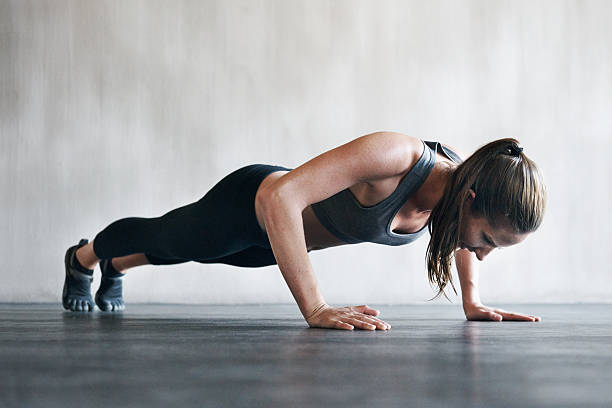
Push-up capacity refers to the number of consecutive push-ups you can perform with proper form before reaching failure.
At first glance, push-ups may seem like a simple fitness test. However, they require multiple components of fitness working together, including:
- Upper-body strength
- Core stability
- Muscular endurance
- Coordination
- Body control
Because push-ups challenge several muscle groups at once, they can provide valuable insight into your overall fitness level, physical function, and healthy aging.
Why Is Push-Up Capacity Important?
I’ll admit it: this is one of my favorite longevity benchmarks on the list.
I’ve always liked push-ups because they’re simple, effective, and accessible to almost everyone. You don’t need a gym membership, expensive equipment, or years of training experience to start doing them.
At the same time, don’t let their simplicity fool you. Push-ups can be surprisingly challenging and provide valuable insight into your strength, muscular endurance, and overall fitness level.
One of the goals of healthy aging is maintaining strength and independence throughout life.
While most people associate push-ups with military training or gym class, they are actually a useful longevity benchmark because they measure relative strength. In other words, they assess your ability to move your own body weight through space.
Research has found that individuals with higher levels of muscular strength and endurance tend to experience better long-term health outcomes than those who are sedentary.
Push-ups also mimic movements we perform throughout everyday life.
Whether you’re pushing yourself up from the floor, getting out of bed, carrying groceries, or performing household chores, strength matters.
As we’ve discussed throughout this article, longevity is not simply about living longer. It’s about maintaining the physical abilities that allow you to enjoy life as you age and preserve your healthspan.
How To Measure Push-Up Capacity
Perform as many push-ups as possible with proper form.
A proper push-up generally includes:
- Maintaining a straight line from head to heels.
- Lowering your chest toward the floor.
- Pushing back to the starting position under control.
- Avoiding excessive sagging or arching of the lower back.
Count only repetitions performed with good form.
What Is A Good Score?
As a general benchmark:
Men:
- Excellent: 40+ push-ups
- Good: 25-39 push-ups
- Average: 10-24 push-ups
- Needs Improvement: Less than 10 push-ups
Women:
- Excellent: 30+ push-ups
- Good: 20-29 push-ups
- Average: 5-19 push-ups
- Needs Improvement: Less than 5 push-ups
Remember that age, body weight, injuries, and training experience can all influence your results.
The goal is not to compare yourself to others. The goal is to establish a baseline and improve over time.
How To Improve Push-Up Capacity
Like most longevity tests, improvement comes through consistent practice.
Some effective strategies include:
- Push-ups
- Incline push-ups
- Bench press
- Dumbbell press
- Planks
- Tricep exercises
If you cannot perform a traditional push-up yet, start with incline push-ups against a wall, countertop, or bench and gradually progress from there.
If regular push-ups become too easy, you can increase the challenge by wearing a weighted vest.
Adding extra resistance forces your muscles to work harder and can help build additional strength and muscular endurance. In many ways, weighted push-ups are similar to adding weight to a squat or bench press—you are progressively increasing the demand placed on your body.
Just make sure you can perform standard push-ups with proper form before adding extra weight.
ACG Fitness Takeaway
One reason I like push-ups as a longevity benchmark is because they require very little equipment.
You don’t need an expensive gym membership.
You don’t need a personal trainer.
You don’t need the latest fitness gadget.
You simply need enough strength and determination to challenge yourself.
Push-ups remind us that healthy aging isn’t just about cardiovascular fitness. Strength matters too.
After all, if your goal is to remain active and independent for decades to come, maintaining muscle and strength is just as important as maintaining a healthy heart.
And if you’ve been paying attention, you’ll notice another familiar pattern.
The same habits that improve your push-up capacity—strength training, physical activity, proper recovery, and adequate sleep—are the same habits that support many of the other longevity benchmarks we’ve discussed.
Once again, the body works as a system.
9. Weekly Activity Minutes

What Are Weekly Activity Minutes?
Weekly activity minutes refer to the total amount of time you spend exercising or engaging in meaningful physical activity throughout the week.
Unlike some of the other longevity benchmarks we’ve discussed, this one is less about performance and more about consistency.
You don’t need to be the strongest person in the gym.
You don’t need the highest VO2 Max.
You don’t need to run marathons.
You simply need to move your body regularly.
When it comes to healthy aging, consistency often beats intensity.
Why Are Weekly Activity Minutes Important?
If you’ve been paying attention throughout this article, you’ve probably noticed that many of these longevity benchmarks are connected.
Regular physical activity can help improve:
- Resting Heart Rate
- Recovery Heart Rate
- VO2 Max
- Walking Speed
- Balance
- Strength
- Sleep Quality
In many ways, physical activity is the foundation that supports nearly every other benchmark on this list.
That’s why organizations like the CDC and World Health Organization recommend regular exercise as one of the most effective ways to improve long-term health and healthspan.
How To Measure Weekly Activity Minutes
Fortunately, this benchmark is simple to track.
You can use:
- Apple Watch
- Garmin
- Fitbit
- Smart Ring
- Smartphone Health App
- Workout Log
Track the amount of time you spend engaging in activities such as:
- Walking
- Strength Training
- Swimming
- Cycling
- Running
- Boxing
- Group Fitness Classes
The goal is to measure intentional movement, not just exercise.
What Is A Good Goal?
Weekly Activity Minutes
(Excellent)
- 300+ minutes per week
(Good)
- 150-299 minutes per week
(Average)
- 75-149 minutes per week
(Needs Improvement)
- Less than 75 minutes per week
Remember, some movement is always better than none.
How To Increase Your Activity Minutes
The easiest way to increase your activity minutes is to stop thinking of exercise as something that only happens in the gym.
Some simple ways to move more include:
- Taking daily walks
- Using the stairs
- Swimming
- Strength training
- Playing sports
- Gardening
- Parking farther away
- Walking during phone calls
Small increases performed consistently can add up quickly over time.
ACG Fitness Takeaway
If I had to choose just one benchmark for someone who is completely new to fitness, this might be it.
Why?
Because improving your weekly activity minutes often improves everything else.
Walk more and your cardiovascular fitness improves.
Exercise regularly and your resting heart rate may improve.
Stay active and you’ll likely maintain more strength, mobility, and balance as you age.
You don’t have to be perfect.
You don’t have to train every day.
You just have to move more than you did yesterday.
Sometimes the simplest advice is still the best advice.
And when it comes to longevity and healthy aging, regular movement remains one of the most powerful tools available.
10. Sleep Duration and Quality

What Is Sleep Quality?
Most people think sleep is simply the number of hours spent in bed.
While sleep duration is important, sleep quality matters too.
Sleep quality refers to how well you sleep throughout the night. Factors such as falling asleep quickly, staying asleep, and waking up feeling refreshed all contribute to quality sleep.
In other words, eight hours of interrupted sleep is not necessarily the same as eight hours of restorative sleep.
Both quantity and quality matter when it comes to healthy aging and longevity.
Why Is Sleep Important?
If you’ve been paying attention throughout this article, you’ve probably noticed that every benchmark we’ve discussed is connected in some way.
Sleep may be the ultimate example.
Poor sleep can negatively affect:
- Resting Heart Rate
- Recovery Heart Rate
- VO2 Max
- Strength
- Balance
- Walking Performance
- Exercise Recovery
- Overall Healthspan
During sleep, your body repairs tissues, regulates hormones, consolidates memories, and prepares for the next day.
Consistently poor sleep has been associated with increased risks of:
- Obesity
- Heart Disease
- Type 2 Diabetes
- Depression
- Cognitive Decline
In other words, sleep isn’t just recovery from exercise.
It’s recovery from life.
How To Measure Sleep
The simplest way to measure sleep is by tracking how many hours you sleep each night.
Many people also use tools such as:
- Apple Watch
- Garmin Watch
- Smart Rings
- Sleep Tracking Apps
These tools can provide additional insights into sleep patterns and recovery.
However, you don’t need expensive technology to determine whether your sleep is improving.
Ask yourself a few simple questions:
- Do I wake up feeling rested?
- Do I sleep through the night?
- Do I have energy throughout the day?
- Do I rely heavily on caffeine to function?
Your answers can often reveal just as much as a sleep tracker.
What Is A Good Sleep Goal?
For most adults:
- Excellent: 7-9 hours consistently
- Good: 6-7 hours consistently
- Average: 5-6 hours consistently
- Needs Improvement: Less than 5 hours regularly
Keep in mind that individual needs can vary slightly, but most adults perform best within the 7-9 hour range.
How To Improve Sleep Quality
Improving sleep often comes down to improving habits.
Some strategies that may help include:
- Maintaining a consistent bedtime
- Limiting screen time before bed
- Keeping your bedroom cool and dark
- Avoiding large meals late at night
- Exercising regularly
- Reducing stress
Just like fitness, small improvements can compound over time.
ACG Fitness Takeaway
If I could give most people one piece of longevity advice, it wouldn’t be to buy a supplement or fitness gadget.
It would be to get more sleep.
Sleep is one of the few things that can improve nearly every benchmark we’ve discussed in this article.
Better sleep can improve your recovery.
Better sleep can improve your performance.
Better sleep can improve your healthspan.
And perhaps most importantly, better sleep can help you feel better today while also improving your chances of aging well tomorrow.
That’s why I consider sleep one of the most powerful—and most underrated—longevity tools available.
If sleep is an area where you’re struggling, I recently wrote a more detailed guide on how to get better quality sleep. In that article, I break down the habits, routines, and lifestyle changes that have helped me improve my own sleep quality over the years. How To Get Better Quality Sleep
Tools That Can Help You Track Your Longevity Benchmarks
Opening disclaimer:
Before we discuss specific tools, remember that you do not need expensive gadgets to improve your health. Most of the longevity benchmarks in this article can be measured with little more than consistency and effort. However, the right tools can make tracking your progress easier and help keep you accountable. There will be links to each one of these items below
Cardiovascular Fitness Tools
- Apple Watch
- Garmin Watch
- Omni Health Ring ( Use Code Omni 15 for 15% off)
- Heart Rate Monitors
Supports:
- Resting Heart Rate
- Recovery Heart Rate
- VO2 Max
- Activity Minutes
Strength & Mobility Tools
Supports:
- Grip Strength
- Sit-to-Stand Test
- Push-Up Capacity
Push-Up Training Tools
Supports:
- Push-Up Capacity
Sleep Tracking Tools
- Omni Health Ring ( Use Code Omni 15 for 15% off)
- Apple Watch
Supports:
- Sleep Duration & Quality
Closing thought:
While these tools are not necessary, I do highly recommend them if you’re serious about improving your health and monitoring your longevity benchmarks over time. They can provide valuable feedback, help keep you accountable, and make it easier to identify both strengths and areas for improvement.
Just remember that the goal isn’t to collect data for the sake of collecting data. The goal is to use that information to make better decisions and take meaningful action.
After all, a fitness tracker can’t make you healthier.
But the actions you take because of what you learn from it certainly can.
Conclusion
After reviewing these 10 longevity benchmarks, you may have discovered areas where you excel and areas where you need improvement.
That’s okay.
In fact, that’s the entire point.
Remember what Kobe Bryant said:
“Failure doesn’t exist. It’s a learning lesson.”
The purpose of these longevity benchmarks is not to judge yourself. They are not here to tell you whether you’re healthy or unhealthy, and they certainly aren’t meant to compare you to someone else on social media.
Instead, these benchmarks are designed to help you better understand your health and identify opportunities for improvement.
Maybe your resting heart rate is excellent, but your sleep needs work.
Maybe your VO2 Max is strong, but your balance could be better.
Maybe you’re active every week, but your push-up capacity isn’t where you’d like it to be.
None of that means you’ve failed.
It simply means you’ve identified your next area of growth.
One of the biggest lessons I hope you take away from this article is that health is not determined by a single number. It isn’t determined by the scale, your BMI, your body fat percentage, or whether you have visible abs.
True health is multifaceted.
It’s your ability to move.
Your ability to recover.
Your ability to remain strong, independent, and capable as you age.
Most importantly, it’s your ability to continue doing the things you love for as long as possible.
That’s what longevity is really about.
Not just adding years to your life, but adding life to your years.
The good news is that improving your healthspan doesn’t require perfection.
You don’t need the perfect workout program.
You don’t need the perfect diet.
You don’t need the latest biohacking trend.
You simply need to make consistent choices that move you in the right direction.
Walk a little more.
Sleep a little better.
Lift some weights.
Challenge your balance.
Track your progress.
Then repeat.
Over time, those small actions compound into meaningful results.
At ACG Fitness, we believe that Action Creates Greatness.
The best time to start improving your health was years ago.
The second-best time is today.
So take these benchmarks, see where you stand, and get to work.
Your future self will thank you for it.
Download Your Free ACG Fitness Healthspan Scorecard 🌹
Want to know how your health really stacks up?
I’ve created the ACG Fitness Healthspan Scorecard to help you track all 10 longevity benchmarks discussed in this article, identify your strengths, and uncover opportunities for improvement. Whether your goal is better cardiovascular fitness, more strength, improved sleep, or simply aging well, this scorecard gives you a simple way to measure your progress over time.
Enter your email below to receive your free copy and join the ACG Fitness community. You’ll also get future fitness, longevity, nutrition, and healthy aging content delivered directly to your inbox.
Remember: what gets measured gets managed.
Download your scorecard, establish your baseline, and reassess every 90 days to see how far you’ve come and where you need to improve.
Action Creates Greatness. 🌹
2 thoughts on “How Healthy Are You Really? 10 Longevity Benchmarks Everyone Should Know”