Introduction
Guys, I’m in my early 30s, and I’ll say this right up front. I don’t want kids. Not today. Not tomorrow. I never want them. End of story.
But for the men who do want children someday, there’s something about male fertility that I keep seeing online that needs to be challenged.
Spend enough time watching podcasts like Fresh & Fit, the Whatever Podcast, or scrolling through social media, and you’ll eventually hear the same message.
Women need to have children while they’re young because fertility declines with age, but men can supposedly wait as long as they want. After all, Al Pacino became a father in his 80s, so what’s the rush?
The problem is that this argument leaves out an important part of the conversation.
While men can remain fertile much later in life than women, male fertility is still influenced by age, body weight, nutrition, sleep quality, exercise, smoking, alcohol consumption, and overall health. In other words, just because a man can have children later in life doesn’t necessarily mean those are the best conditions for his reproductive health.
This article isn’t about telling anyone when they should or shouldn’t have children.
It’s about making sure men understand that reproductive health isn’t just the woman’s responsibility.
A healthy pregnancy begins with two healthy people.
If becoming a father is one of your life goals, your health matters too.
The good news is that many of the same habits that improve male fertility are also the same habits that support your heart, help you maintain a healthy weight, improve longevity, and increase your overall quality of life.
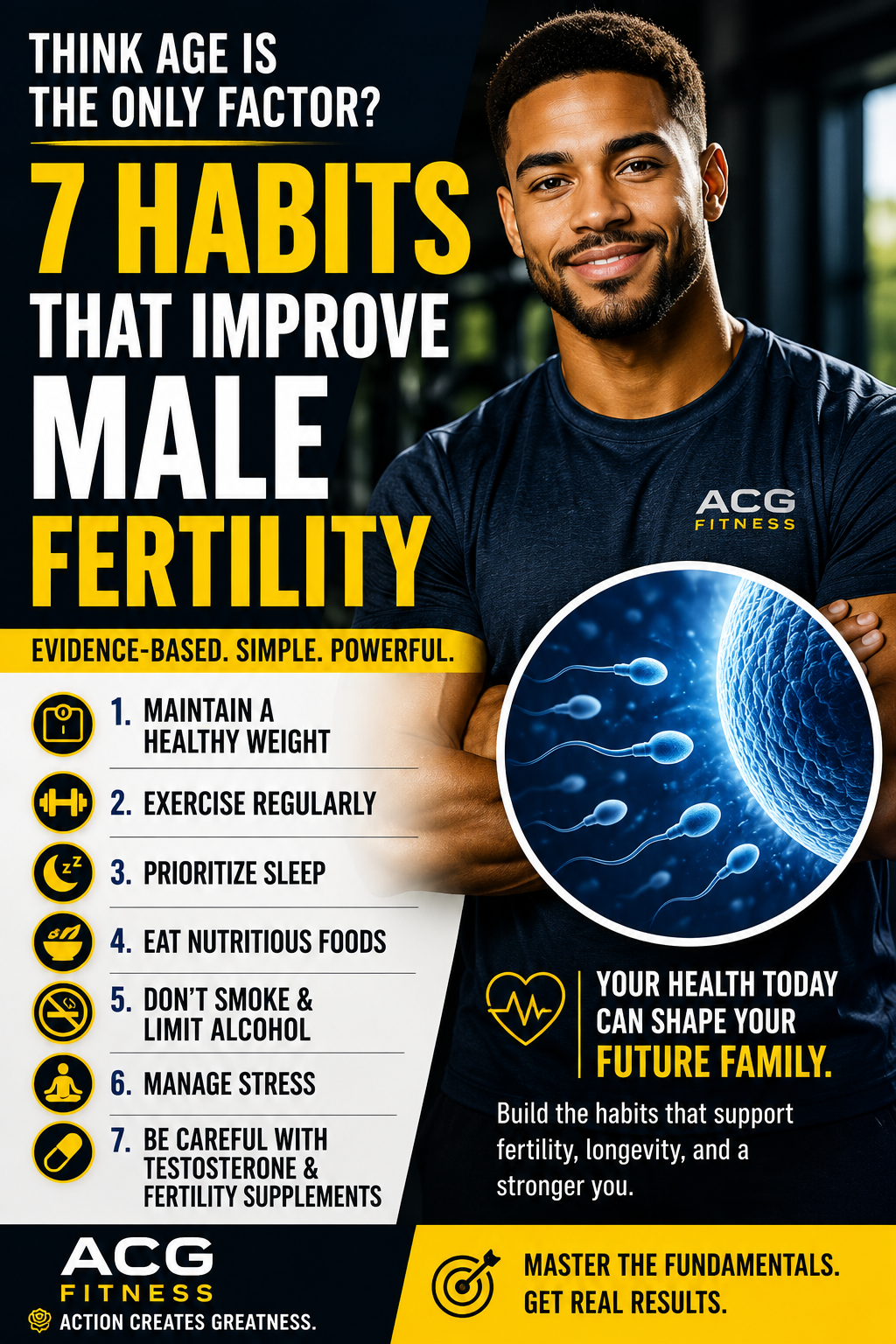
Let’s look at seven lifestyle habits that can improve your reproductive health.
Why Does Male Fertility Matter?
Before we get into the lifestyle habits, let’s clear up one important misconception.
When most people hear the words male fertility, they immediately think about whether a man can get someone pregnant.
That’s certainly part of it.
But male fertility is about much more than that.
Healthy sperm don’t just increase the chances of conception. Research suggests that a father’s age and overall health may also influence sperm quality, DNA integrity, pregnancy outcomes, and even the long-term health of his future children.
That doesn’t mean every unhealthy man will struggle to have children.
It also doesn’t mean every older father will experience fertility problems.
What it does mean is that your health plays a bigger role than many people realize.
The good news is that supporting male fertility doesn’t require some expensive supplement stack or a secret biohacking routine.
In fact, many of the same habits that improve reproductive health are the exact same habits that help you build muscle, maintain a healthy weight, improve your cardiovascular health, and increase your chances of living a longer, healthier life.
In other words…
Improving your fertility isn’t just about becoming a better father someday.
It’s about becoming a healthier man today.
How to Improve Male Fertility Naturally
Now that we’ve established why male fertility matters, the next question is obvious.
How do you improve it?
The good news is that supporting male fertility isn’t nearly as complicated as social media makes it seem.
You don’t need an expensive supplement stack.
You don’t need to spend thousands of dollars on the latest biohacking gadgets.
And you certainly don’t need to believe every influencer promising to boost your testosterone overnight.
In reality, many of the same habits that improve male fertility are the exact same habits that reduce your risk of heart disease, help you maintain a healthy weight, build muscle, improve your energy levels, and increase your chances of living a longer, healthier life.
That’s one of the reasons I wanted to write this article.
Whether you plan on having children or not, becoming a healthier man is never a bad investment.
If you do hope to become a father someday, these lifestyle habits may not only improve your overall health, but they may also help support your reproductive health as well.
Let’s start with one of the biggest factors affecting male fertility.
1. Maintain a Healthy Body Weight

If you’ve read some of my other articles, then you probably won’t be surprised that maintaining a healthy body weight is at the top of this list.
Whether we’re talking about heart disease, longevity, Type 2 diabetes, or now male fertility, carrying excess body fat increases your risk for a wide range of health problems.
Your reproductive health is no exception.
Research has found that obesity is associated with lower sperm quality, reduced sperm motility (how well sperm swim), lower testosterone levels, increased inflammation, and greater oxidative stress, all of which may make it more difficult to conceive
One reason for this is that body fat isn’t just stored energy.
Fat tissue is biologically active.
It produces hormones and inflammatory compounds that can interfere with your body’s normal hormone balance.
For example, excess body fat can increase the activity of an enzyme called aromatase, which converts testosterone into estrogen.
As testosterone levels decline, sperm production and overall male fertility may also be affected.
Being overweight is also associated with a higher risk of conditions like insulin resistance, metabolic syndrome, and sleep apnea, all of which can further impact your overall health and reproductive health.
The good news is that this works both ways.
Losing excess weight through regular exercise and a healthy diet has been shown to improve many of these underlying risk factors.
Even modest improvements in body weight can have positive effects on your overall health, and they may also help support sperm health and reproductive function.
The goal isn’t to become shredded.
The goal is to become healthier.
Your future heart, your future family, and frankly your future self will all benefit from the same lifestyle changes.
If you’re trying to lose weight, check out our guide on avoiding the most common calorie deficit mistakes to help make your journey a little easier.
5 Powerful Fixes to lose weight
2. Exercise Regularly

If there’s one thing I hope you take away from this article, it’s that male fertility isn’t determined by one magic supplement or one “superfood.”
It’s the result of your overall health.
That’s one of the reasons regular exercise is so important.
Exercise doesn’t just help you burn calories.
It helps you maintain a healthy body weight, improves cardiovascular health, reduces inflammation, supports hormone production, and can all contribute to better reproductive health over time.
Research suggests that men who exercise regularly often have better sperm quality than those who live a sedentary lifestyle. Staying active may also help improve sperm motility and support healthy testosterone levels, although the relationship between exercise and hormone production is influenced by many factors, including your age, body composition, and overall health.
However, more isn’t always better.
While moderate, consistent exercise appears to support male fertility, excessive training without enough recovery can have the opposite effect. Overtraining may increase stress hormones, reduce testosterone, and negatively impact recovery, which is why balance is so important.
You don’t need to become a marathon runner or spend three hours in the gym every day.
In fact, some of the best forms of exercise are also the simplest.
Lifting weights a few days each week, walking more throughout the day, and adding a few sessions of cardiovascular exercise can improve your overall health while also helping you improve male fertility naturally.
I always tell people that consistency beats perfection.
You’re far better off exercising four days a week for the next ten years than going all-in for a month before quitting.
The same principle applies to your health.
If you’ve been following ACG Fitness for a while, then you already know I’m a big believer that exercise is one of the best investments you can make in your health.
That’s why I’ve written dozens of articles on everything from building muscle and improving cardiovascular health to longevity, nutrition, and healthy aging.
If you’re enjoying this article, I’d encourage you to bookmark the blog or subscribe to our newsletter. My goal isn’t just to help you improve your male fertility—it’s to help you become the healthiest version of yourself.
3. Prioritize Your Sleep

I know sleep isn’t the most exciting topic to talk about.
It doesn’t come in a fancy bottle.
No one is making viral TikToks about getting eight hours of sleep.
And unfortunately, you can’t buy more of it at your local supplement store.
But if you’re looking to improve male fertility naturally, getting enough quality sleep may be one of the best investments you can make in your health.
Research suggests that poor sleep is associated with lower testosterone levels, reduced sperm quality, hormonal imbalances, and a greater risk of obesity—all of which can negatively affect male fertility over time.
Your body performs some of its most important recovery processes while you sleep.
Hormones are regulated.
Muscle tissue repairs itself.
Your brain processes information.
Your immune system recovers.
In many ways, sleep is when your body prepares itself for tomorrow.
Unfortunately, this is also where I think many men get into trouble.
We stay up scrolling social media, playing video games, binge-watching Netflix, or convincing ourselves that we’ll “catch up on sleep later.”
The problem is that your body doesn’t work that way.
Consistently getting five or six hours of sleep night after night isn’t the same as pulling one all-nighter.
Sleep debt adds up over time, and your body eventually pays the price.
If you recently read my article about whether creatine can replace sleep, then you already know my answer.
Supplements can support your health.
They cannot replace the biological need for sleep.
If your goal is to support reproductive health, improve your energy levels, build muscle, or simply become a healthier man, prioritize your sleep.
Future you will thank you for it.
If you need help getting better quality sleep, I wrote an article that you can check out here for 10 life changing sleep hacks to help you out
4. Eat a Nutrient-Dense Diet

If you’ve been reading ACG Fitness for a while, then you probably knew this section was coming.
And you probably knew I was going to mention spinach.
I promise I’m not sponsored by any big spinach companies.
In fact, as I’m writing this article, I’m getting ready to eat spinach and sardines for lunch.
Not because I’m trying to have kids.
I’m not.
I’m eating them because they’re incredibly nutritious foods that support my overall health, provide high-quality protein, healthy fats, vitamins, minerals, and nutrients that help support normal hormone production and muscle recovery.
That’s really the point.
There isn’t one magical fertility food.
However, there are foods that consistently show up in healthy dietary patterns associated with better male fertility, sperm quality, and overall reproductive health.
Spinach is one of my favorites because it’s rich in folate, magnesium, vitamin C, and antioxidants that help protect your cells from oxidative stress.
Sardines are another excellent choice because they’re packed with protein, omega-3 fatty acids, vitamin D, selenium, and other nutrients that support your heart, brain, and overall health. Omega-3 fats have also been studied for their role in supporting healthy sperm health and sperm membrane function.
Will eating spinach and sardines suddenly double your testosterone or dramatically improve your fertility?
No.
That’s not how nutrition works.
The goal isn’t to find one miracle food.
The goal is to consistently eat foods that give your body the nutrients it needs to perform at its best.
5. Don’t Smoke and Limit Alcohol

If there’s one theme you’ve probably noticed throughout this article, it’s that male fertility is really a reflection of your overall health.
The healthier your body is, the better chance it has to perform every job it’s supposed to do—including producing healthy sperm.
That’s why smoking and excessive alcohol consumption deserve their own section.
Smoking has consistently been associated with poorer sperm quality, lower sperm count, reduced sperm motility, and increased DNA damage. Cigarette smoke contains thousands of chemicals that increase oxidative stress throughout the body, and your reproductive system isn’t immune to those effects.
Alcohol is a little more complicated.
Having an occasional drink probably isn’t going to destroy your male fertility overnight.
The concern is chronic, excessive alcohol consumption.
Heavy drinking has been linked to hormonal imbalances, lower testosterone levels, liver dysfunction, and poorer reproductive health, all of which may negatively affect fertility over time.
Notice something?
None of these habits only affect your fertility.
Smoking increases your risk of heart disease, stroke, cancer, and chronic lung disease.
Excessive alcohol increases your risk of liver disease, high blood pressure, poor sleep, and weight gain.
Once again, the habits that improve male fertility are often the exact same habits that improve your chances of living a longer, healthier life.
If you’re planning on becoming a father one day, quitting smoking and drinking responsibly may be one of the best gifts you can give both yourself and your future family.
6. Manage Stress

Let’s be honest.
Completely eliminating stress isn’t realistic.
Life is stressful.
Work is stressful.
Money is stressful.
Relationships are stressful.
If you’ve been following ACG Fitness recently, then you already know I’ve been dealing with plenty of stress myself over the past few weeks.
The goal isn’t to live a stress-free life.
The goal is learning how to manage it.
Research suggests that chronic stress may negatively affect male fertility by disrupting hormone production and increasing cortisol levels. Over time, elevated stress may also contribute to poor sleep, unhealthy eating habits, reduced physical activity, and other lifestyle factors that can affect reproductive health and sperm quality.
In other words, stress rarely shows up by itself.
It usually brings a few unhealthy habits along with it.
That’s why I always encourage people to find healthy ways to manage stress before it starts managing them.
For me, that’s lifting weights.
It’s taking walks.
Reading. I’ve been reading Meditations by Marcus Aurelius. I’m only a few chapters in, but it’s already changing the way I think about stress, uncertainty, and focusing on the things I can actually control. I will link to a copy here on Amazon if you want to check it out. Meditations
Playing a video game every now and then.
Spending time with people I care about.
Your stress relief might look completely different, and that’s okay.
The important thing is finding something healthy that allows you to reset instead of turning to habits that may hurt your long-term health.
You don’t have to remove every stressful situation from your life.
You just need to build healthy habits that help you respond to stress in a better way.
Your heart will benefit.
Your mind will benefit.
And if becoming a father is one of your future goals, your male fertility may benefit as well.
7. Be Careful With Testosterone and Fertility Supplements
One group I’m particularly concerned about is young men.
Social media has made “looksmaxxing,” testosterone optimization, and anabolic steroids seem almost normal. Everywhere you look, someone is telling young men they need higher testosterone, a stronger jawline, bigger muscles, or a more masculine appearance.
I understand the appeal.
Who doesn’t want to look and feel their best?
But if becoming a father is one of your goals someday, you need to think beyond what you see in a 30-second social media clip.
External testosterone and anabolic steroids can suppress your body’s natural sperm production. In other words, chasing a better physique today could make it more difficult to have children tomorrow.
That’s a trade-off many young men never hear about.
A few months ago, I even wrote an article about clavicle width because I was seeing so many young men becoming obsessed with changing parts of their bodies they simply can’t change.
Now I’m seeing a similar trend with hormones.
My advice is simple.
Don’t risk your long-term health or your future family because an influencer convinced you that more testosterone is always better.
Build your body naturally.
Lift weights.
Eat nutritious foods.
Sleep well.
Stay active.
If you truly believe you have low testosterone or another hormonal issue, talk with a qualified healthcare professional instead of trying to diagnose yourself through social media.
Your future self will thank you for it.
Does Age Affect Male Fertility?
There isn’t a simple yes or no answer to this question.
Can men become fathers later in life?
Absolutely.
Unlike women, men don’t experience menopause, and many are capable of having children well into their 50s, 60s, and even beyond.
That’s one of the reasons celebrities like Al Pacino, Robert De Niro, and others often make headlines when they become fathers later in life.
However, there’s an important difference between being able to have children and optimizing male fertility.
Research suggests that male fertility gradually declines with age. As men get older, sperm count, sperm quality, sperm motility, and DNA integrity may all begin to decline. Advanced paternal age has also been associated with a higher risk of certain pregnancy complications and some health conditions in children, although it’s important to remember that the overall risk for many couples remains relatively low.
This doesn’t mean every older father will experience fertility problems.
Nor does it mean young fathers are guaranteed to have healthy pregnancies.
Health is rarely that simple.
What it does mean is that age is one piece of the puzzle.
Your body weight.
Your diet.
Your exercise habits.
Your sleep.
Your stress levels.
Whether you smoke or drink excessively.
All of these lifestyle factors can influence male fertility and reproductive health throughout your life.
That’s why I wanted to write this article.
The conversation shouldn’t be about whether men have a biological clock that’s exactly the same as women.
It should be about helping young men understand that their health matters too.
Whether you’re planning to have children in five years or twenty years, taking care of your body today gives you the best chance of protecting your health tomorrow.
Frequently Asked Questions About Male Fertility
Does Age Affect Male Fertility?
Yes. While men can remain fertile much later in life than women, research suggests that male fertility gradually declines with age. Older men may experience changes in sperm quality, sperm motility, DNA integrity, and overall reproductive health. This doesn’t mean older men can’t have healthy children, but it does mean that age is another factor worth considering if becoming a father is one of your long-term goals.
How Can I Improve Male Fertility Naturally?
The best way to improve male fertility naturally is by focusing on the fundamentals.
Maintain a healthy body weight, exercise regularly, prioritize sleep, eat a nutrient-dense diet, avoid smoking, limit excessive alcohol consumption, and manage your stress. While some supplements may be helpful in certain situations, healthy lifestyle habits remain the foundation of good reproductive health.
Does Exercise Improve Male Fertility?
Yes, regular exercise may help support male fertility by improving cardiovascular health, maintaining a healthy weight, reducing inflammation, and supporting healthy hormone production.
However, balance is important. Excessive training without enough recovery may negatively affect hormone levels and overall health.
What Foods Are Good For Male Fertility?
There isn’t one magical fertility food.
Instead, focus on eating a balanced diet rich in fruits, vegetables, lean protein, whole grains, healthy fats, and antioxidant-rich foods.
As you’ve probably noticed throughout ACG Fitness, I’m a big fan of spinach because it’s packed with nutrients like folate, magnesium, and antioxidants. I also regularly eat sardines because they’re an excellent source of protein and omega-3 fatty acids that support overall health.
The goal isn’t to find one superfood.
The goal is to consistently fuel your body with foods that support long-term health.
Can Testosterone Therapy Affect Male Fertility?
Yes.
This is one of the biggest misconceptions I see online.
External testosterone therapy and anabolic steroids can suppress your body’s natural sperm production, which may reduce male fertility.
If you’re planning to have children in the future, it’s important to discuss your goals with your healthcare provider before starting testosterone therapy or using performance-enhancing drugs.
Conclusion
As I said at the beginning of this article, I’m in my early 30s, and I don’t want children.
Not today.
Not tomorrow.
Probably not ever.
But that doesn’t mean I can’t appreciate how important male fertility is for the men who do hope to become fathers someday.
That’s one of the reasons I wanted to write this article.
For far too long, conversations about fertility have focused almost entirely on women while ignoring the fact that a father’s age, lifestyle, and overall health also play an important role in reproductive health.
The good news is that you don’t need to overcomplicate your fitness.
You don’t need expensive supplements.
You don’t need miracle foods.
And you certainly don’t need to believe every influencer promising to optimize your hormones overnight.
Most of the habits that help improve male fertility naturally are the same habits that improve nearly every other aspect of your health.
Maintain a healthy body weight.
Exercise consistently.
Prioritize your sleep.
Eat nutritious foods.
Manage stress.
Avoid smoking and excessive alcohol.
Those habits won’t just support your fertility.
They’ll help you build a stronger body, improve your heart health, increase your energy, and give you a better chance of living a longer, healthier life.
If you’re planning to start a family, I’d also encourage you to read our guide on supporting a healthy pregnancy. A healthy pregnancy begins with two healthy people, and understanding both sides of the equation is one of the best gifts you can give your future family.
If you’re new to ACG Fitness, welcome.
Whether your goal is to build muscle, improve your longevity, lose weight, or simply become a healthier version of yourself, I hope you’ll take a few minutes to explore the rest of the blog. I’ve written dozens of evidence-based articles designed to help you cut through the noise and focus on what actually works.
And if you enjoyed this article, consider subscribing to our newsletter so you never miss future content.
Remember…
Action Creates Greatness.