Guys, look.
I know we have been here before.
In fact, the last time I wrote about creatine, I jokingly said I was done talking about it. No more creatine articles. No more creatine debates. No more “Is creatine safe?” questions.
And yet… here we are again.
I keep seeing claims online about creatine, and most of them are harmless. Some are exaggerated. A few are just plain ridiculous.
But recently I came across one of the wildest fitness claims I’ve seen in a long time:
Can creatine replace sleep?
Apparently, the answer is yes—at least according to some people on social media.
Now, I have been lifting weights for over a decade. I’ve taken creatine for years. I’ve read countless studies on it, recommended it to others, and even ranked it as one of the few supplements that is actually worth your money.
But can creatine replace sleep?
That stopped me in my tracks.
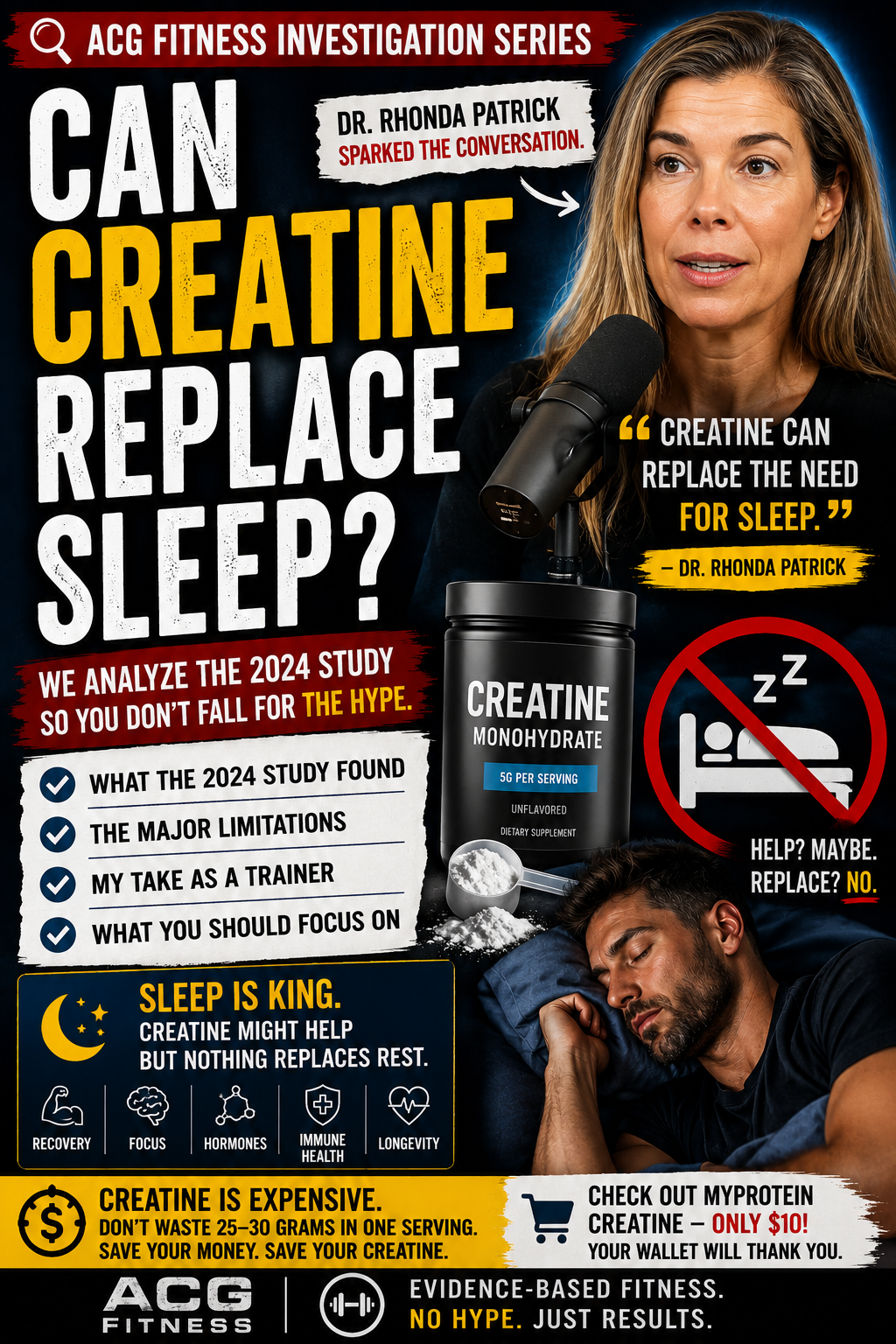
The claim gained attention after Dr. Rhonda Patrick discussed research suggesting that high doses of creatine may help reduce some of the negative effects of sleep deprivation. Somewhere along the way, that scientific discussion turned into social media posts claiming that creatine can actually replace sleep.
Those are two very different things.
So in this article, we’re going to break down what the Dr. Rhonda Patrick creatine claims actually are, what the research shows about creatine and sleep deprivation, and whether creatine can realistically make up for a bad night’s sleep.
Spoiler alert: if you’re hoping a scoop of creatine will let you stay up until 2 AM watching Netflix and still feel amazing the next day, you’re probably going to be disappointed.
Who Is Dr. Rhonda Patrick?

Before we discuss whether creatine can replace sleep, it’s important to understand where this claim came from.
Dr. Rhonda Patrick is a biomedical scientist and researcher who is best known for her work in nutrition, aging, longevity, and human performance. She has appeared on numerous podcasts, including several episodes of the Joe Rogan Experience, and has built a large following by discussing the science behind topics such as exercise, sleep, supplements, fasting, and healthy aging.
Unlike many influencers in the fitness industry, Dr. Patrick typically bases her recommendations on scientific research rather than personal anecdotes. That doesn’t mean everyone agrees with her conclusions, but it does mean her opinions tend to carry more weight than the average social media fitness guru.
Over the years, she has become one of the most respected voices in the health and longevity space. If you’ve spent any time researching topics such as vitamin D, omega-3 fatty acids, cold exposure, sauna use, or longevity, you’ve probably come across her work at some point.
This is one of the reasons the claim that creatine may help offset sleep deprivation gained so much attention. When a respected scientist discusses an interesting study, people listen.
One thing I appreciate about Dr. Patrick is that she generally tries to follow the research wherever it leads. As someone who enjoys reading studies and learning about fitness, I can respect that.
At the same time, I think there is a tendency in the health and fitness space to overcomplicate things.
Sometimes people become so focused on finding the optimal supplement, the optimal workout split, or the optimal recovery strategy that they forget about the basics.
The reality is that most people don’t need a perfect training program.
They need consistency.
They need to get to the gym.
They need to go for a walk.
They need to eat enough protein.
And they need to stop cheating themselves.
That’s one reason claims like “creatine can replace sleep” get so much attention. People are always looking for a shortcut when the truth is usually much less exciting.
Most of the time, the basics are still doing the heavy lifting.
The problem is that scientific findings often get distorted as they spread across social media.
A researcher might say:
“This supplement may help reduce some of the negative cognitive effects of sleep deprivation.”
By the time that message makes its way through YouTube Shorts, TikTok clips, Instagram Reels, and fitness forums, it often becomes:
“Creatine replaces sleep.”
Those are not the same thing.
So before we jump to conclusions, let’s take a look at what Dr. Rhonda Patrick actually said and where this claim came from in the first place.
What Did Dr. Rhonda Patrick Actually Say?
Before we go any further, take a look at the clip below where Dr. Rhonda Patrick discusses creatine and sleep deprivation.
I’ll be honest.
The first time I heard this clip, I thought there was no way that could be true.
According to Dr. Patrick, researchers found that if you deprive someone of sleep for approximately 21 hours and then give them 25 to 30 grams of creatine, it can completely negate the cognitive deficits associated with sleep deprivation.
Not only that, but she goes on to suggest that the participants may have actually performed better on certain cognitive tests than people who were fully rested.
That’s a pretty incredible claim.
And if you’re anything like me, your first reaction is probably:
“Hold on. If that were true, why is everyone still sleeping?”
After all, sleep isn’t just important. It’s one of the most fundamental biological processes we have.
Sleep affects:
- Recovery
- Hormone production
- Muscle growth
- Memory formation
- Mood
- Immune function
- Long-term health
The idea that a supplement could simply replace all of that sounds almost too good to be true.
To be fair, I don’t think Dr. Patrick was telling people to stop sleeping and start taking creatine instead.
What she was doing was discussing a fascinating study that looked at how creatine affects cognitive performance during periods of sleep deprivation.
The problem is that when a statement like this gets clipped and shared online, the nuance often disappears.
Suddenly, “creatine may help maintain cognitive performance after sleep loss” becomes:
“Creatine replaces sleep.”
And those are very different claims.
So before we throw our mattresses in the trash and start buying creatine by the bucket, let’s take a closer look at what the research actually found.
What Does The Research Say About Creatine and Sleep Deprivation?
The claim that creatine can replace sleep appears to come primarily from a 2024 study titled:
“Single Dose Creatine Improves Cognitive Performance and Induces Changes in Cerebral High Energy Phosphates During Sleep Deprivation.”
You can read the full study here:
https://www.nature.com/articles/s41598-024-54249-9
In the study, researchers kept participants awake for approximately 21 hours and administered a high dose of creatine monohydrate. They found that creatine improved cognitive performance and processing speed compared to a placebo during sleep deprivation. The researchers concluded that a high dose of creatine may help partially reverse some of the cognitive deterioration associated with sleep loss.
That’s fascinating research.
But notice what the study does not say.
It does not say that creatine replaces sleep.
It does not say that creatine restores hormone production.
It does not say that creatine improves muscle recovery after sleep deprivation.
And it certainly does not suggest that people should stop sleeping and start taking 30 grams of creatine instead.
The study was looking specifically at cognitive performance during sleep deprivation. In other words, researchers wanted to know whether creatine could help the brain function better when someone had been awake for an extended period of time.
The answer appears to be yes.
At least under these specific experimental conditions.
This is where many social media discussions go off the rails.
“Creatine may help reduce some of the cognitive effects of sleep deprivation” becomes:
“Creatine replaces sleep.”
Those are very different conclusions.
In fact, even researchers reviewing the broader literature on creatine and brain health have noted that the benefits seen during sleep deprivation are generally modest and may depend on the task being performed and the severity of the sleep loss.
So while the research on creatine cognitive performance and creatine brain benefits is certainly promising, the evidence does not support the idea that creatine can replace sleep.
The Limitations of This Research
While the research on creatine and sleep deprivation is certainly interesting, there are several important limitations that often get ignored when this study is discussed online.
1. The Dose Was Extremely High
The first thing that jumped out at me was the amount of creatine used in the study.
Most people take between 3 and 5 grams of creatine monohydrate per day. Even traditional loading protocols typically involve 20 grams per day spread across multiple servings.
The participants in this study received approximately 25 to 30 grams of creatine.
That’s a lot of creatine.
Could that dose improve cognitive performance during sleep deprivation?
Possibly.
Is that the amount most people are taking every day?
Absolutely not.
When discussing creatine brain benefits, it’s important to remember that the results of a high-dose research study don’t always translate directly to real-world use.
2. Acute Sleep Deprivation Is Different Than Chronic Sleep Deprivation
Another important limitation is that researchers were studying acute sleep deprivation.
In simple terms, participants stayed awake for an extended period of time and researchers measured how creatine affected their cognitive performance.
That’s very different from the type of sleep deprivation most people experience.
Most people aren’t pulling all nighters.
Instead, they’re sleeping five or six hours per night for weeks, months, or even years.
Those situations are not the same.
Just because creatine may help support cognitive performance after one night of sleep loss does not mean it can protect you from the long-term consequences of chronic sleep deprivation.
3. Cognitive Performance Is Only One Piece Of The Puzzle
This is probably the biggest issue I have with the way this research is discussed online.
The study focused on cognitive performance.
It did not measure every aspect of human health.
Sleep affects far more than your ability to think clearly.
Sleep impacts:
- Muscle recovery
- Hormone production
- Testosterone levels
- Hunger and appetite regulation
- Immune function
- Mood
- Long-term health and longevity
So even if creatine helps maintain cognitive performance after sleep deprivation, that doesn’t mean your body has fully recovered.
You can feel mentally sharp and still be physiologically sleep deprived.
4. Improved Performance Does Not Mean Sleep Is Optional
This is where I think many people misunderstand the research.
The question researchers were asking was:
“Does creatine help with sleep deprivation?”
The answer appears to be yes.
At least to some degree.
But that is a completely different question than:
“Can creatine replace sleep?”
The current evidence does not support that conclusion.
In fact, the study itself was investigating whether creatine could reduce some of the cognitive deficits caused by sleep deprivation—not eliminate the biological need for sleep altogether.
That’s an important distinction.
The research on creatine cognitive performance is promising.
The research on creatine brain benefits is exciting.
But none of the available evidence suggests that creatine can replace sleep.
And that’s where we need to separate scientific findings from social media hype.
5. We Still Don’t Fully Understand The Timing
Another question I had while reading this research was the timing of the creatine supplementation itself.
Most people who take creatine for strength and muscle growth understand that the benefits don’t usually appear overnight.
In fact, one reason many people use a creatine loading phase is to help saturate muscle stores more quickly. Even then, it typically takes several days before creatine levels become fully elevated.
That raises an interesting question.
If creatine often requires time to saturate muscle tissue, why would we assume the brain immediately experiences the full cognitive benefits after a single high dose?
To be fair, the brain and muscles are different tissues, and researchers are still learning about the relationship between creatine and cognitive performance.
However, this highlights another reason why we should be careful when interpreting these results.
The study suggests that high-dose creatine may help support cognitive performance during sleep deprivation under specific conditions.
What it does not prove is that a single dose of creatine can consistently overcome the effects of sleep deprivation in the real world.
More research is needed before we can confidently make that leap.
My Take: Can Creatine Replace Sleep?
After reviewing the research, listening to the Dr. Rhonda Patrick creatine explanation, and looking at the limitations of the study, I think my position is pretty simple.
Can creatine replace sleep?
No.
Not even close.
Can creatine help with sleep loss?
For long term sleep deprivation, that is also no.
Now, before the creatine fans come after me, let me be clear. I love creatine.
I’ve written multiple articles about it on ACG Fitness because it is one of the few supplements that consistently lives up to the hype. If you haven’t already, check out my Creatine Myth Busting Guide, where I break down some of the most common misconceptions surrounding creatine supplementation.
The evidence supporting creatine for strength, muscle growth, recovery, and even cognitive performance is impressive.
But sleep is still king.
Every single time.
One of the biggest mistakes I see in the fitness industry is that people are constantly looking for ways to avoid doing the fundamentals. They want the perfect supplement, the perfect workout split, the perfect biohack, or the perfect longevity shortcut.
The reality is that most people would get far better results by simply improving their sleep habits.
If you’re sleeping five hours per night, staying up scrolling social media, eating poorly, and skipping workouts, adding more creatine isn’t going to solve those problems.
This is where I think the discussion around creatine and sleep deprivation gets a little misleading.
Could creatine help maintain cognitive performance during periods of sleep deprivation?
Possibly.
The research suggests it might.
Could creatine provide certain brain benefits under specific circumstances?
Again, the research suggests it might.
But helping with sleep deprivation and replacing sleep are two completely different things.
Sleep impacts nearly every aspect of your health:
- Recovery
- Hormone production
- Memory formation
- Mood
- Immune function
- Muscle growth
- Long-term longevity
A supplement simply cannot replace all of those biological processes.
In fact, if I had to choose between:
- Eight hours of quality sleep and no creatine
- Four hours of sleep and 30 grams of creatine
I’m choosing sleep every single time.
And honestly, if you’re taking 25 to 30 grams of creatine in one sitting, there’s a good chance you’ll discover another problem before you unlock some secret cognitive superpower.
Your stomach.
Most people only need 3 to 5 grams of creatine per day. That’s the amount I recommend for the average person looking to improve performance and support overall health.
The good news is that you don’t have to choose between creatine and sleep.
You can have both.
Take your creatine.
Train hard.
Eat enough protein.
And get a full night’s sleep.
If improving recovery is your goal, I would spend far more time focusing on sleep quality than searching for a supplement that can supposedly replace it. In fact, I recently wrote an article on How to Get Better Quality Sleep, which I highly recommend reading if recovery, performance, and longevity are important to you.
At the end of the day, I think Dr. Rhonda Patrick highlighted an interesting area of research. The relationship between creatine cognitive performance and sleep deprivation is certainly worth studying further.
But based on the current evidence, the answer to the question “Can creatine replace sleep?” remains the same.
No.
Sleep is still the most powerful recovery tool available.
Creatine is an excellent supplement.
The two work best together.
Frequently Asked Questions
Can creatine replace sleep?
No. Current research does not support the idea that creatine can replace sleep. While some studies suggest that high doses of creatine may help reduce certain cognitive effects of short-term sleep deprivation, sleep is still essential for muscle recovery, hormone production, immune function, memory consolidation, and overall health.
Can creatine help with sleep loss ?
Possibly. Research suggests that creatine may help support cognitive performance during short periods of sleep deprivation. However, this does not mean it eliminates the negative effects of sleep loss or replaces the need for adequate sleep.
Does creatine improve cognitive performance?
There is growing evidence that creatine may improve certain aspects of cognitive performance, particularly during mentally demanding situations or sleep deprivation. More research is still needed to determine how significant these benefits are for the average healthy adult.
Can I take 25 to 30 grams of creatine every day?
I wouldn’t recommend it unless you’re participating in a research study or following advice from a qualified healthcare professional. Most research supports taking 3 to 5 grams of creatine monohydrate daily for long-term performance and health benefits. Taking much larger amounts may increase the likelihood of stomach discomfort and digestive issues without providing additional benefits.
Is creatine good for your brain?
Emerging research suggests that supports creatine brain benefits for energy production and cognitive performance under certain conditions, including sleep deprivation. However, scientists are still studying the potential brain benefits of creatine, and it should not be viewed as a replacement for healthy habits like quality sleep, regular exercise, and proper nutrition.
Should I take creatine if I don’t exercise?
Possibly. While creatine is most commonly associated with strength training, researchers are also studying its potential benefits for healthy aging, brain health, and cognitive function. However, if your goal is better overall health, your first priorities should still be regular physical activity, a balanced diet, and getting enough sleep.
What is the best way to improve recovery?
In my opinion, the best recovery strategy isn’t a supplement it’s consistency. Prioritize 7 to 9 hours of quality sleep, eat enough protein, stay active, manage stress, and consider evidence-based supplements like creatine to support your routine. Supplements should enhance healthy habits, not replace them.
More Fitness Claims We’ve Investigated
The fitness industry moves fast.
Every week there’s a new supplement, a new biohack, or another viral claim that promises to change everything.
Some of those claims are backed by solid science.
Others get exaggerated as they spread across social media.
That’s why I created this series—to separate the evidence from the hype and help you make informed decisions about your health.
If you enjoyed this article, you might also like:
- Creatine Myth Busting: Common creatine myths that simply won’t die.
- 10 Longevity Benchmarks Everyone Should Know: Learn how to measure your health beyond the number on the scale. (Internal Link)
- How to Get Better Quality Sleep: Because no supplement will ever replace consistently getting enough sleep. (Internal Link)
- Protein Shortage: Are you actually eating enough protein to support your goals? (Internal Link)
- Read This Before Taking Ozempic: My thoughts on one of the most controversial topics in fitness today. (Internal Link)
Don’t Lose This Article
Let’s be honest.
The next time someone on TikTok, Instagram, YouTube, or Facebook tells you that creatine can replace sleep, you’re probably going to want to come back and read this again.
Instead of searching Google all over again, just tap the ♡ Save button powered by Grow to bookmark this article.
That way you’ll have it saved in your personal library whenever you want to revisit it—or send it to a friend who’s convinced that 30 grams of creatine is somehow better than eight hours of sleep.
I’m going to continue investigating popular fitness claims, reviewing the latest research, and calling out the hype when I see it.
So if you enjoy straightforward, evidence-based fitness advice without all the unnecessary complexity, be sure to follow ACG Fitness through Grow so you can bookmark your favorite articles and never miss the next investigation.
Because in fitness, the loudest claim isn’t always the most accurate.
Conclusion: Can Creatine Replace Sleep?
So, can creatine replace sleep?
After reviewing the research, my answer is still no.
The current evidence suggests that creatine may help support cognitive performance during short periods of sleep deprivation, but it does not replace the countless biological processes that happen while you’re asleep.
Guys, please don’t overcomplicate your health.
One thing I’ve learned after more than a decade of lifting weights is that people spend far too much time looking for shortcuts instead of mastering the basics.
Get your sleep.
Seriously.
Sleep feels good.
It feels great, actually.
And it’s one of the easiest, cheapest, and most effective things you can do for your health.
If your goal is to build muscle, lose fat, improve your workouts, sharpen your mind, or live a longer, healthier life, I’d focus on getting seven to nine hours of quality sleep long before worrying about whether creatine can replace it.
And one more thing…
Creatine isn’t free.
Before you start taking 25 to 30 grams because you saw it in a research study or a viral social media clip, remember that most people can experience the well-established benefits of creatine with just 3 to 5 grams per day.
Don’t burn through an entire tub of creatine trying to copy a research protocol that wasn’t designed for everyday use.
Save your money.
Save your creatine.
And if you’re looking for an affordable option, check out my recommended MyProtein Creatine using the link below. It’s one of the best values I’ve found, and your wallet will probably thank you too.
MyProtein: https://tidd.ly/4eGA342
That’s really what ACG Fitness is all about.
I love reading new research. I enjoy investigating viral fitness claims and challenging popular opinions. But I also believe that science should help simplify your health not make it more complicated.
Train consistently.
Eat enough protein.
Take creatine if it fits your goals.
And when it’s time for bed…
Go to sleep.
Your body will thank you far more than any supplement ever could.